Cosmic gamma rays test the limits of Einstein’s speed of light rule
Cosmic photon timing measurements help constrain possible departures from relativity, with no violation detected in the analysis.
 Edited By: Joshua Shavit

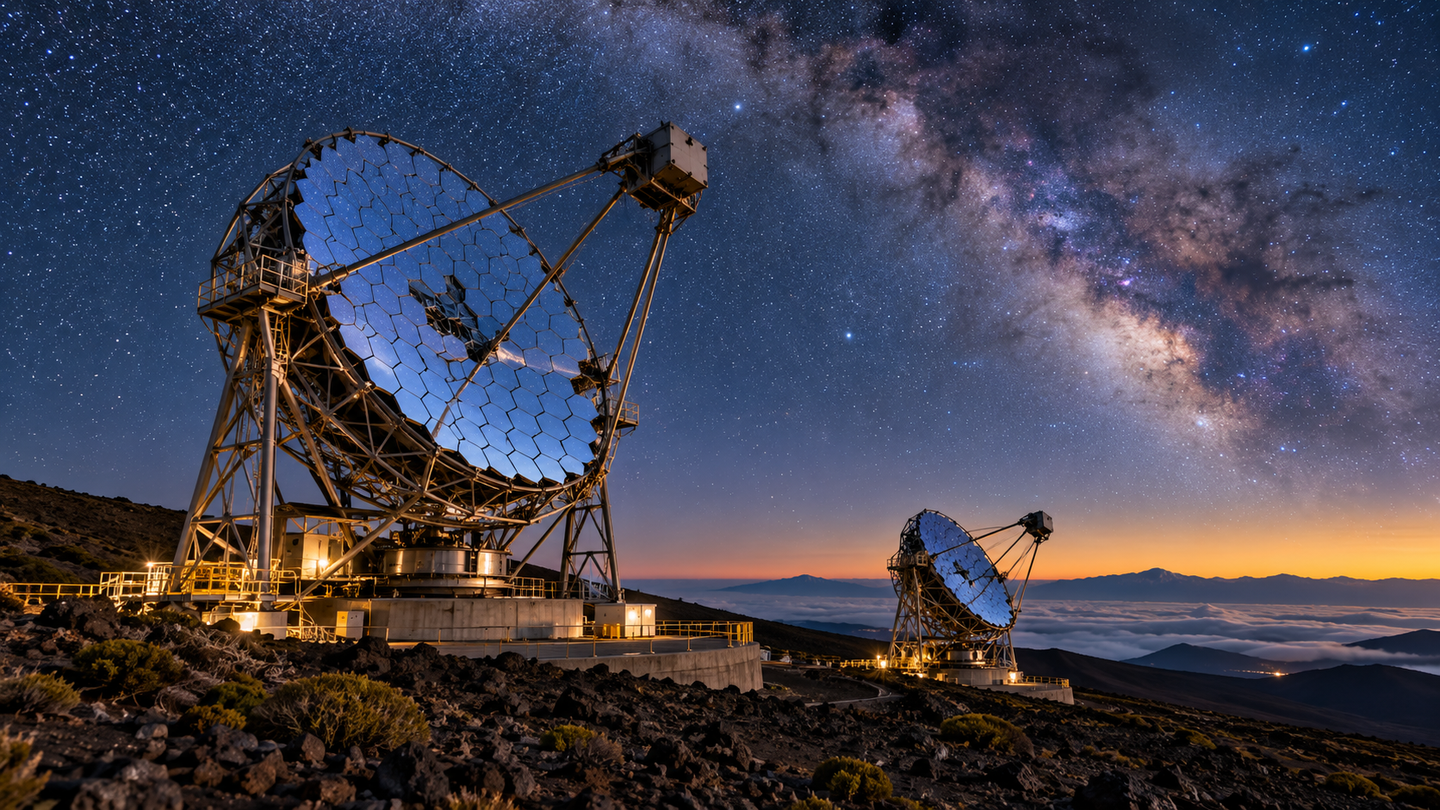
A gamma-ray reanalysis tightens specific limits on violations of Einstein’s light-speed rule by roughly a factor of ten. (CREDIT: Shutterstock)
- A reanalysis of cosmic gamma-ray measurements found no evidence of the tested departures from Lorentz invariance.
- The researchers tightened limits on specific photon-sector parameters by about a factor of ten using a standardized statistical approach.
- The findings constrain certain models of new physics, while uncertainties in source emission and detector measurements remain important.
Light crossing the universe offers an unusually long test of one of physics’ most important principles. If high-energy photons traveled even slightly faster or slower than lower-energy photons, their arrival times could gradually separate over immense distances. Astronomers can search for that difference in brief, energetic cosmic events.
A team led by Mercè Guerrero has used existing gamma-ray measurements to sharpen that search. Their analysis, published in Physical Review D, improved bounds on specific parameters describing possible violations of Lorentz invariance by about an order of magnitude, or a factor of ten.
The study found no evidence of the tested violations. Its contribution is a tighter connection between astronomical measurements and a theoretical framework for departures from established physics. The result limits particular possibilities, rather than settling every question about light propagation or quantum gravity.
Why the speed of light remains under scrutiny
Special relativity holds that the laws of physics are the same for observers in uniform relative motion. Lorentz invariance also rules out a preferred spatial direction in those laws. The constant speed of light in vacuum is central to this framework.
The principle has survived more than a century of testing. In 1887, Albert Michelson and Edward Morley compared light traveling along different directions while seeking evidence of Earth’s motion through a proposed light-carrying medium. Their null result became a landmark in the development of modern physics.
Lorentz symmetry subsequently became a foundation of relativistic quantum field theory and the Standard Model of particle physics. These frameworks describe particles and their interactions with extraordinary experimental success. That record makes departures difficult to detect, but also makes a credible departure scientifically important.
Gravity presents another part of the problem. General relativity describes gravity through the geometry of spacetime, while quantum theory describes matter and interactions through a different mathematical framework. Building a complete theory that incorporates gravity’s quantum behavior remains an unresolved task.
Some proposed quantum-gravity scenarios allow tiny violations of Lorentz symmetry. Testing that possibility gives physicists a way to constrain those proposals. It does not mean that every approach to quantum gravity predicts a changing speed of light.
Letting distance magnify a tiny effect
The observational idea begins with photons of different energies emitted at the same time. Under the usual light-speed rule, their energies alone would not cause them to travel through vacuum at different speeds. Certain alternative models predict a small energy-dependent difference.
Over a short journey, such an effect could be too small to measure. A much longer journey allows a tiny difference in travel speed to accumulate into a potentially detectable arrival-time delay. Very-high-energy gamma rays provide a useful means of looking for these effects.
Brief or rapidly changing astronomical sources provide the timing information needed for that comparison. Relevant observations include gamma-ray bursts, active galactic nuclei and pulsars. Researchers examine when photons arrive and how their arrival patterns vary with energy.
An observed delay would still need careful interpretation. Photons of different energies may leave a source at different times, so an arrival-time difference need not arise during propagation. Detector uncertainties also influence how accurately energies and timing patterns can constrain an effect.
Translating observations into theoretical limits
The study brought together Guerrero, Anna Campoy-Ordaz, Robertus Potting and Markus Gaug. Their affiliations span the University of Aveiro, the University of Algarve and Universitat Autònoma de Barcelona, with links to the Institute of Space Studies of Catalonia. The collaboration connected astronomical measurements with the mathematical description of possible symmetry violations.
The researchers worked within the Standard-Model Extension, or SME. This framework describes possible departures from Lorentz symmetry through parameters whose sizes experiments can constrain. It gives different measurements a common theoretical language.
The analysis focused on a particular class of photon effects whose leading energy dependence is quadratic. It also considered effects that can vary with direction across the sky. Such directional dependence matters because observations along one line of sight cannot fully characterize every possible pattern.
The team standardized published bounds, accounting for detector uncertainties, correcting missing mathematical factors and reconciling statistical conventions. They then translated those bounds into SME parameters. Combining measurements from different directions allowed them to constrain individual coefficients more tightly.
What a tenfold improvement establishes
An order-of-magnitude improvement means the allowed size of the relevant departures becomes substantially smaller. A model predicting an effect beyond those bounds would conflict with the measurements under the analysis’s assumptions. Models producing smaller effects can remain compatible with the observations.
The improvement applies to specific photon-sector coefficients. It is not a tenfold improvement in every test of relativity, nor a direct measurement of light’s speed under all conditions. The scope of the result follows the particular effects and observations included.
The absence of a detected violation also leaves the broader quantum-gravity question open. It shows that the tested effects have not emerged at the sensitivity available. Further constraints can help distinguish viable proposals from those that predict excluded behavior.
Source timing remains an important limitation. An intrinsic emission delay could complicate interpretation of a propagation effect, including potentially offsetting it. Tests using varied sources and distances help address that uncertainty rather than relying on one favorable observation.
The next tests need better observations
The Cherenkov Telescope Array Observatory offers a future opportunity to extend these searches. Its planned improvements in gamma-ray sensitivity and energy coverage are intended to support studies of both extreme astrophysical environments and fundamental physics. More sensitive observations could reveal smaller effects or strengthen existing bounds.
Different sources also provide different tests of the same theoretical assumptions. A larger, more varied collection of observations can help separate behavior within a source from changes accumulated during travel. That distinction is essential before any timing anomaly could count as evidence for new physics.
For now, the light-speed rule has withstood another examination. The useful outcome is a smaller range of allowed departures and a clearer method for comparing measurements. Future tests can build on that framework while continuing to scrutinize the uncertainties behind each bound.
Dig deeper into light speed and quantum-gravity tests
These resources explore gamma-ray timing measurements, alternative propagation models and the broader search for observable quantum-gravity effects.
Discriminating between different modified dispersion relations from gamma-ray observations: This study examines how alternative models predict different relationships between photon delays and source distance. (Physical Review D, 2025)
Stringent Tests of Lorentz Invariance Violation from LHAASO Observations of GRB 221009A: Gamma rays from an exceptionally bright burst provide constraints on energy-dependent photon propagation. (Physical Review Letters, 2024)
Constraints on Lorentz invariance violation from the extraordinary Mrk 421 flare of 2014 using a novel analysis method: This analysis uses a rapidly varying galactic nucleus to test possible energy-dependent arrival delays. (Journal of Cosmology and Astroparticle Physics, 2024)
Quantum gravity phenomenology at the dawn of the multi-messenger era—A review: A broad review surveys theoretical proposals and observational approaches to testing quantum gravity. (Progress in Particle and Nuclear Physics, 2022)
First Combined Study on Lorentz Invariance Violation from Observations of Energy-dependent Time Delays from Multiple-type Gamma-Ray Sources. I. Motivation, Method Description, and Validation through Simulations of H.E.S.S., MAGIC, and VERITAS Data Sets: This paper develops and tests a method for combining timing constraints from different gamma-ray source classes. (The Astrophysical Journal, 2022)
Research findings are available online in the journal Physical Review D.
The original story "Cosmic gamma rays test the limits of Einstein’s speed of light rule" is published in The Brighter Side of News.
Related Stories
- Inside the strange physics of why time stops at the speed of light
- Darkness can travel faster than the speed of light — without breaking Einstein’s relativity
- New discovery rewrites what we know about the speed of light
Like these kind of feel good stories? Get The Brighter Side of News' newsletter.
Joseph Shavit
Writer, Editor-At-Large and Publisher
Joseph Shavit, based in Los Angeles, is a seasoned science journalist, editor and co-founder of The Brighter Side of News, where he transforms complex discoveries into clear, engaging stories for general readers. With vast experience at major media companies like The Los Angeles Times, Times Mirror and Tribune Publishing, he writes with both authority and curiosity. His writing focuses on space science, planetary science, quantum mechanics, geology. Known for linking breakthroughs to real-world markets, he highlights how research transitions into products and industries that shape daily life.