Animals may have evolved 200 million years earlier than previously thought
Missing animals in exceptionally preserved rocks expose uncertainty in the fossil constraints used to date the animal kingdom.
 University of Oxford Writer: Ross Anderson

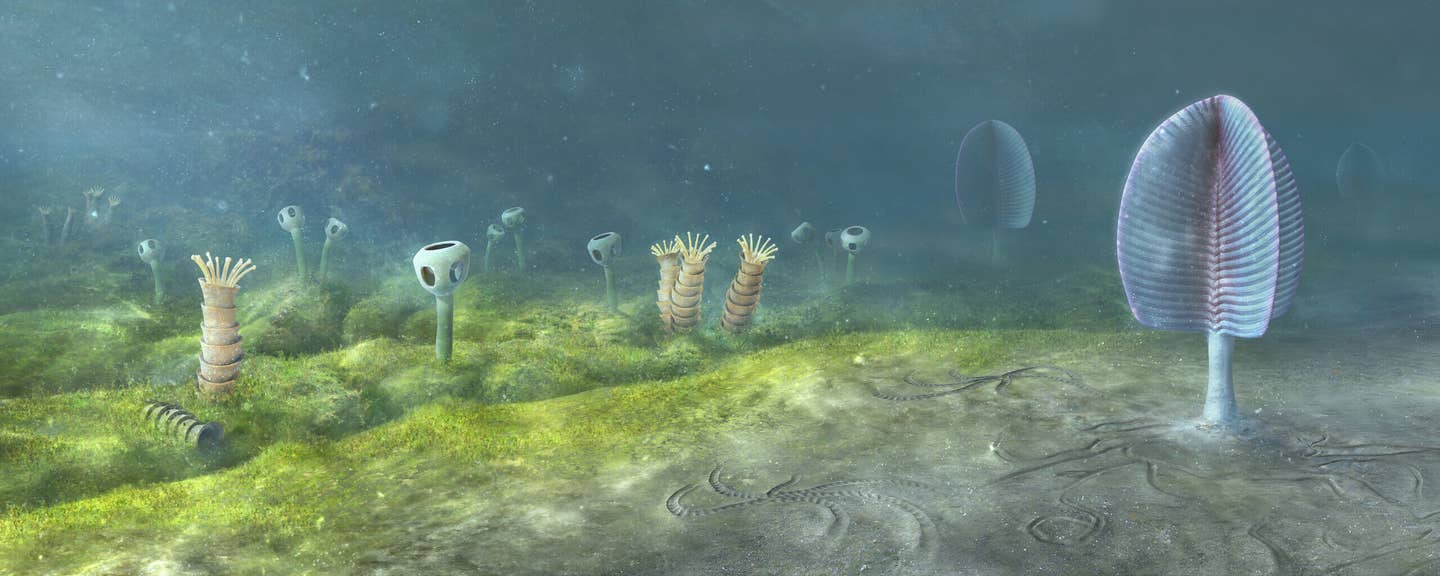
Ediacaran sea floor, Namibia, Southwest Africa – 543 million years ago. (CREDIT: Museum of Natural History, University of Oxford / Mighty Fossils)
- Exceptionally preserved Mongolian microfossils challenge the assumption that missing animal fossils establish when animals first evolved.
- Molecular-clock analyses using older geological constraints place the common ancestor of living animals roughly 800 to 700 million years ago.
- The findings reopen the possibility of animal origins before Snowball Earth, but do not establish that animals existed 800 million years ago.
Tiny fossils from Mongolia are reopening a much larger question: how long did animals exist before they left unmistakable remains in the rocks? Their importance comes from what the deposit fails to preserve, despite capturing microscopic life in extraordinary detail.
An Oxford-led study in Science Advances challenges a geological assumption that has helped keep some estimates of animal origins relatively young. When the team used older constraints in molecular-clock analyses, the estimated common ancestor of living animals shifted back to roughly 800 to 700 million years ago.
That is around 200 million years earlier than estimates obtained using a younger fossil deposit as an upper age limit. It could place animal origins before, or during, the extreme glaciations known as Snowball Earth.
The researchers did not discover an 800-million-year-old animal. Their findings show how an uncertain assumption about fossil preservation can substantially alter an evolutionary timeline.
bar: 0.1 mm. (CREDIT: Derek Briggs.)
When missing fossils become a dating assumption
The oldest unmistakable macroscopic animal fossils date to about 574 million years ago. They establish that animals existed by then, but cannot tell us exactly when their evolutionary history began.
To estimate earlier dates, scientists use molecular clocks. These compare genetic differences among living species and combine them with evolutionary-rate models and dates from the rock record.
Fossils provide reference points, or calibrations. A securely identified animal fossil sets a minimum age: its lineage must already have existed when that organism lived. Setting a maximum age requires a different argument, usually that animals would have been preserved in an older deposit if they were present.
China’s roughly 590-million-year-old Weng’an Biota has played an important role in that reasoning. Its exquisitely preserved microscopic organisms include no definitive animals, although the identities of some fossils remain disputed. This absence has been used or proposed as an upper age constraint for particular animal groups.
The central assumption is that exceptional preservation makes absence meaningful. The Oxford team tested whether that logic holds in a younger, comparable deposit.
Mongolia provides a revealing comparison
The researchers surveyed more than 140 samples from the Kheseen Biota, including material from previously undocumented localities near Mongolia’s Lake Khuvsgul. Their international team included scientists from the University of California, Berkeley, ETH Zürich and Yale University.
Scanning electron microscopy revealed delicate spines, branching projections and fine surface ornamentation. The fossils included acritarchs, organic-walled microfossils whose biological identities can be uncertain, and embryo-like forms containing internal cellular structures.
The work expanded the assemblage’s known diversity to 16 acritarch species, eight newly documented there. Some preserved surface ridges narrower than one micrometer, showing how faithfully these rocks can record tiny biological features.
Yet none of the fossils could be confidently identified as animals. An embryo-like appearance alone does not establish that an organism belonged to the animal kingdom.
The fossil-bearing Kheseen rocks are younger than 550 million years, with the team favoring an age between about 534 and 526 million years. The precise dating remains uncertain, but the deposit formed after animals had already appeared elsewhere.
That makes its missing animals particularly informative. Excellent preservation did not produce an animal record even when animals were known to exist.
Exceptional preservation still leaves gaps
“The Kheseen Biota breaks the argument that the exceptional microfossils of Weng'an mean we would have seen animal fossils in the assemblage had they existed at the time,” said senior author Ross Anderson of the Oxford University Museum of Natural History.
There are several possible explanations. Animals may have occupied environments that these deposits did not sample, or the chemical conditions responsible for preserving other organisms may have failed to preserve animal remains.
Early animals also may have been especially difficult to recognize. Small, soft bodies without mineralized skeletons would leave fewer durable clues than the shells and bones familiar from younger fossil deposits.
The comparison does not demonstrate that animals lived when Weng’an formed. It weakens the argument that their absence there establishes that they had not evolved.
A deposit can preserve some kinds of life beautifully while providing an incomplete picture of the wider living world.
Older constraints move the molecular clock
The team examined older candidate calibrations from the Tonian Period, including Norway’s Svanbergfjellet Formation, Australia’s Bitter Springs Group and Arizona’s Chuar Group. These fossil-rich deposits date broadly to between 850 and 730 million years ago.
They contain no recognized animal fossils, but their preservation pathways offer potential for recording delicate organisms. Using them as maximum age constraints produced estimates placing the common ancestor of living animals roughly 800 to 700 million years ago.
Those estimates depend on the calibration selected. They concern the ancestry shared by living animal lineages, rather than an observed moment when the first animal appeared.
The older deposits also have limitations. Their missing animal fossils could reflect incomplete preservation, unsuitable environments or difficulties recognizing the earliest animals. The authors therefore argue that molecular-clock models should acknowledge greater uncertainty in these maximum bounds.
Chemical evidence provides another line of inquiry. Ancient molecular signatures have been interpreted as consistent with sponges living at least 650 million years ago, although identifying the biological sources of such biomarkers has been debated.
A possible history before Snowball Earth
An origin between 800 and 700 million years ago would overlap a major environmental transition. The Cryogenian Period began around 720 million years ago and included episodes when glaciers spread across much of the planet.
An older timeline keeps open questions about whether those glaciations influenced early animal evolution. It does not establish that ice ages caused animals to evolve, or explain how their earliest communities survived.
“Pre-Ediacaran animal body fossils still elude us, and this analysis does not prove that animals existed 800 million years ago,” said first author Orin Lole Durbin.
Future work must compare deposits from different environments and regions, considering body fossils, traces of activity and chemical biomarkers together. As Anderson put it, “Until that evidence becomes available, the precise birth date of the animal kingdom remains uncertain.”
Dig deeper
These resources explore competing evolutionary timelines, fossil preservation and the environmental setting of early animal life.
Independent origins of spicules reconcile paleontological and molecular evidence of sponge evolutionary history: Examines sponge skeletal evolution and supports a contrasting, younger estimate of sponge origins. (Science Advances, 2026)
Ediacaran origin and Ediacaran-Cambrian diversification of Metazoa: Presents the younger animal timeline whose calibration framework the new study reassesses. (Science Advances, 2024)
New study brings us closer to cracking the mystery of when animals first evolved: Explains how mineral chemistry helps scientists assess the preservation potential of ancient rocks. (University of Oxford, 2023)
Uncertainty in the Timing of Origin of Animals and the Limits of Precision in Molecular Timescales: Explores how fossil calibrations and evolutionary-rate variation limit the precision of molecular clocks. (Current Biology, 2015)
Snowball Earth climate dynamics and Cryogenian geology-geobiology: Reviews global glaciations and their geological and biological context. (Science Advances, 2017)
Research findings are available online in the journal Science Advances.
The original story "Animals may have evolved 200 million years earlier than previously thought" is published in The Brighter Side of News.
Related Stories
- How animal feces became an evolutionary force 540 million years ago
- Asgard archaea study reveals new insights into the evolution of complex life
- 55-million-year-old fossil teeth rewrite the story of early primate evolution
Like these kind of feel good stories? Get The Brighter Side of News' newsletter.
Joshua Shavit
Writer and Editor
Joshua Shavit is a NorCal-based science and technology writer with a passion for exploring the breakthroughs shaping the future. As a co-founder of The Brighter Side of News, he focuses on positive and transformative advancements in technology, physics, engineering, robotics, and astronomy. Having published articles on AOL.com, MSN, Yahoo News, and Ground News, Joshua's work highlights the innovators behind the ideas, bringing readers closer to the people driving progress.