Astronomers find an ultra-dense mega-Earth 23 times our planet’s mass but only 2.5 times its size
A young world 23.5 times Earth’s mass may define a rare class of dense planets that sit between rocky worlds and sub-Neptunes.

 Edited By: Joshua Shavit

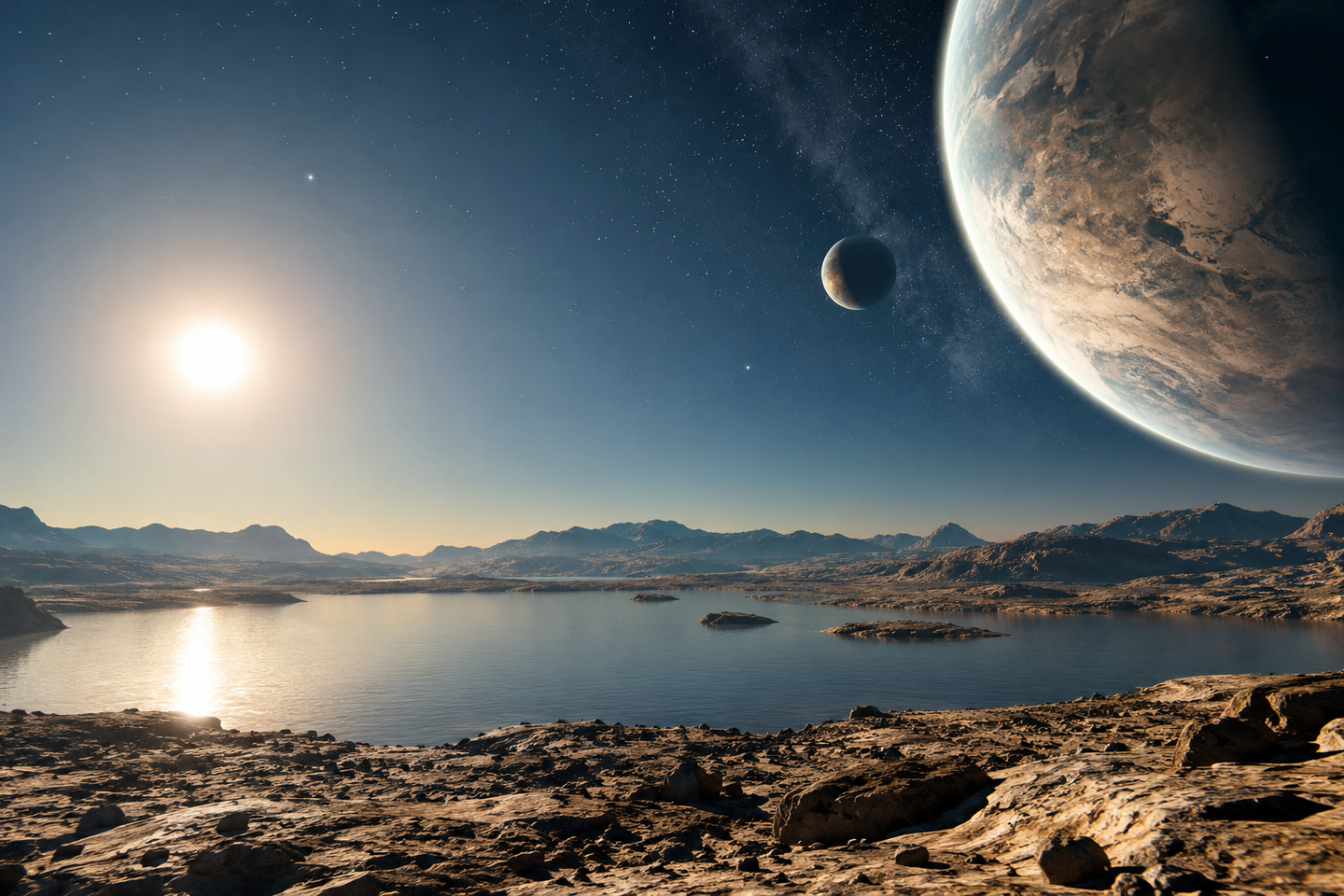
GJ 523b is a dense mega-Earth 2.55 times Earth’s radius, challenging ideas about how large rocky planets form. (CREDIT: Shutterstock)
- GJ 523b is 2.55 times Earth’s radius but about 23.5 times its mass, making it unusually dense for a planet of its size.
- Its high density, apparent lack of a thick hydrogen-helium atmosphere and sharply tilted orbit point to an unusual formation history.
- The team proposes calling planets like this “mega-Earths,” a class defined by large radii and Earth-like or greater densities.
GJ 523b is about 2.5 times wider than Earth, yet it packs roughly 23.5 Earth masses into that space. Its unusual density has pushed astronomers toward a new label for a rare class of worlds: “mega-Earths.”
The planet is the first exoplanet discovered and cataloged by researchers with the Wisconsin Center for Origins Research at the University of Wisconsin–Madison. Max Kroft, a graduate student in Assistant Professor of Astronomy Thomas Beatty’s lab, led the work. The paper is under review and available on the arXiv preprint server.
The system is also remarkably young. The team estimates its age at 169 million years, with an uncertainty ranging from 48 million years younger to 100 million years older. GJ 523b orbits its star every 17.745740 days.
“People have been using the phrase 'Mega-Earth' for more than a decade, but we've never had a planet that let us say concretely what one is,” Beatty says.
A planet that should have looked different
GJ 523b has a radius of 2.55 times Earth’s and a density of 7.8 grams per cubic centimeter. That places it in a size range usually occupied by sub-Neptunes, planets that often carry substantial layers of gas or other low-density material.
This one appears different. Interior modeling suggests it is dominated by rock and water, with little or no significant hydrogen-helium envelope. The researchers argue that its bulk properties make it one of the densest known planets at its radius.
“This isn't what we expected at all,” Kroft says. “Dense planets like this aren't uncommon, but they're usually small rocky planets similar to Earth or Mercury. This planet is two and a half times the size of Earth.”
The planet’s equilibrium temperature is estimated at 538 kelvins. It receives about 13.9 times the sunlight Earth gets from the Sun.
WiCOR researchers had originally been searching for Hycean worlds, a proposed class of planets with large oceans and temperate atmospheres that could potentially support life. GJ 523b did not fit that picture.
TESS spotted the signal, NEID weighed the world
NASA’s Transiting Exoplanet Survey Satellite, or TESS, first identified the candidate by detecting periodic dips in the brightness of its star. Those dips recur as a planet crosses in front of the star and blocks a small fraction of its light.
TESS recorded the system in five observing sectors. The team used three sectors containing planetary transits in its final fit. The measured transit depth was about 1,107 parts per million.
Kroft and colleagues followed the candidate with the NEID high-resolution spectrograph on the WIYN 3.5-meter Telescope at Kitt Peak National Observatory. Thirty radial-velocity measurements helped determine how strongly the planet tugs on its star.
The team also used high-resolution imaging from Gemini North and Palomar Observatory to check for nearby stellar companions that could confuse the measurements. None were detected within the reported sensitivity limits.
Stellar activity complicated the radial-velocity signal. The researchers used an analysis called SCALPELS to separate changes in spectral-line shape, associated with stellar activity, from the Doppler shifts used to measure the planet.
A tilted orbit deepens the mystery
GJ 523b does not simply look unusual inside. Its orbit appears sharply misaligned with the rotation of its host star.
From the star’s radius, rotation period and measured rotational velocity, the team calculated a stellar inclination of about 17.6 degrees. Under the assumptions described in the paper, that implies a minimum three-dimensional orbital obliquity above 71.4 degrees.
That high tilt is difficult to fit into the better-known patterns seen among smaller planets. No companion planet has been found so far, although the team says a distant object could still be hiding beyond the reach of current observations.
The planet’s modest eccentricity of about 0.143 adds another constraint. Some violent migration scenarios could produce a tilted orbit, but the researchers calculate that tidal circularization would be too slow to easily bring a highly eccentric young planet to its current state.
Several formation paths remain possible. GJ 523b could have formed in a tilted protoplanetary disk, or interactions with the disk may have shifted its orbital orientation. Giant impacts might also have stripped away a primordial atmosphere while increasing the planet’s core mass.
Another possibility involves a hybrid of pebble and planetesimal accretion. In that scenario, rapid early growth followed by slower bombardment could delay gas accretion long enough for the surrounding gas disk to dissipate.
Drawing a line around “mega-Earths”
The team proposes an observational definition for mega-Earths: planets with radii from 2.1 to 5 Earth radii and densities of at least 5.5 grams per cubic centimeter.
The classification is meant to separate unusually dense planets from ordinary sub-Neptunes, even when they occupy similar size ranges. The researchers identified 12 other well-characterized planets that meet the proposed criteria, in addition to GJ 523b.
Those worlds vary widely in orbital period, temperature, age, host-star type and system architecture. That diversity argues against treating mega-Earths as products of one shared formation route.
Instead, the proposed category rests on what astronomers can measure: planets above the radius gap that are too dense to contain substantial hydrogen-helium envelopes.
Practical implications of the research
GJ 523b gives astronomers a target for testing how massive, gas-poor planets form and change over time. More radial-velocity observations could reveal a hidden companion that helps explain the planet’s tilted orbit.
Future Gaia data releases may also detect outer companions that current measurements miss. A Rossiter-McLaughlin observation could better constrain the planet’s orbital tilt, while secondary-eclipse observations with the James Webb Space Telescope could test whether it carries a significant atmosphere.
Kroft cautions that one planet cannot establish a formation rule.
“It's hard to infer things about planet formation in general from a sample size of one,” he says. “We're not going to get to 10,000 of these overdense planets, but if we can get to 20 or 30, maybe some trends might pop out, where maybe the heaviest ones have shorter orbital periods, or they tend not to have companion planets.”
Dig deeper into mega-Earths and unusual planet formation
These resources explore the radius gap, dense exoplanet interiors, atmospheric loss and the formation processes that could produce unusually massive rocky worlds like GJ 523b.
A radius valley between migrated steam worlds and evaporated rocky cores
This modeling study argues that the exoplanet radius gap can arise from both atmospheric loss and planet formation, with rocky super-Earths separated from larger, water-rich worlds that migrated inward from colder regions. (Nature Astronomy, 2024)
NCORES programme: precise planetary masses, null results, and insight into the planet mass distribution near the radius gap
Using precise radial-velocity measurements and archival planets, this work finds rocky compositions dominate below the radius gap while planets above it show much greater compositional diversity, supporting multiple formation pathways. (Monthly Notices of the Royal Astronomical Society, 2025)
Can metal-rich worlds form by giant impacts?
Simulations show that giant impacts can create unusually dense, metal-rich planets, but such collisions appear too uncommon to explain most known high-density exoplanets. (Astronomy & Astrophysics, 2025)
Atmosphere loss in oblique Super-Earth collisions
This study models collisions between super-Earth-sized planets and finds that impacts can remove substantial atmospheres, although completely stripping one in a single collision usually requires extreme energies that also erode the rocky planet itself. (Monthly Notices of the Royal Astronomical Society, 2022)
The Nature and Origins of Sub-Neptune Size Planets
This authoritative review examines the radius gap, atmospheric escape, planetary migration and competing formation models for worlds between Earth and Neptune, providing broad context for why dense planets above the gap are so unusual. (Journal of Geophysical Research: Planets, 2021)
Research findings are available online in the journal arXiv.
The original story "Astronomers find an ultra-dense mega-Earth 23 times our planet’s mass but only 2.5 times its size" is published in The Brighter Side of News.
Related Stories
- Astronomers map the climate of Earth-like exoplanets for the first time
- JWST spots a lemon-shaped exoplanet orbiting a pulsar — rewriting the rules of planet formation
- Exoplanet TRAPPIST-1e may hold Earth-like atmosphere, JWST finds
Like these kind of feel good stories? Get The Brighter Side of News' newsletter.
Joseph Shavit
Writer, Editor-At-Large and Publisher
Joseph Shavit, based in Los Angeles, is a seasoned science journalist, editor and co-founder of The Brighter Side of News, where he transforms complex discoveries into clear, engaging stories for general readers. With vast experience at major media companies like The Los Angeles Times, Times Mirror and Tribune Publishing, he writes with both authority and curiosity. His writing focuses on space science, planetary science, quantum mechanics, geology. Known for linking breakthroughs to real-world markets, he highlights how research transitions into products and industries that shape daily life.