The early universe may have been heated by tiny primordial black holes
Tiny primordial black holes could have briefly dominated the early universe before evaporating into hot radiation. New calculations show why a realistic spread of masses would weaken a gravitational-wave signal once expected to test that scenario.
 Uni-Mainz Writer: Maximilian Holl

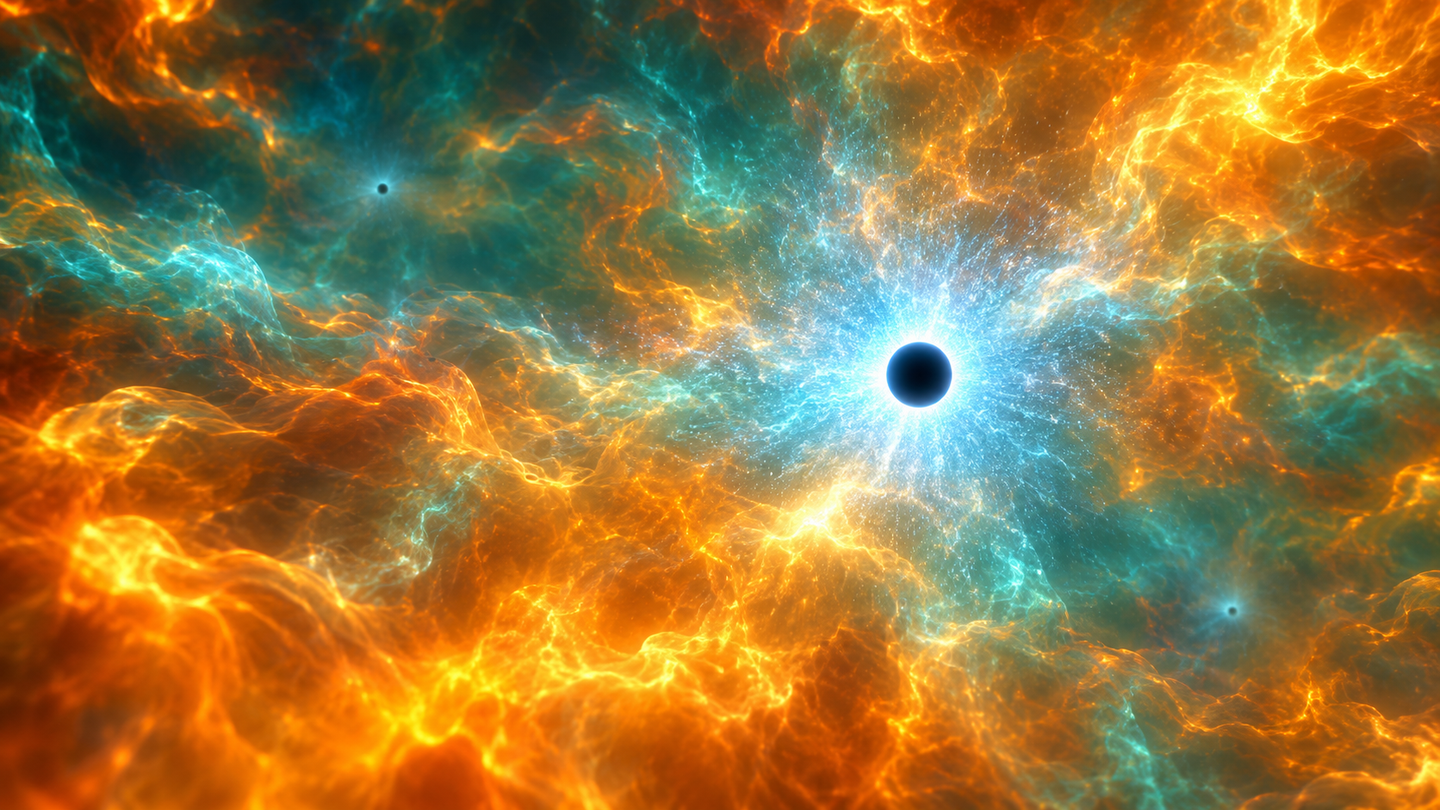
Artist’s visualization of hypothetical primordial black holes releasing energy into the young universe. New modelling suggests their evaporation could have reheated the cosmos while producing fainter gravitational waves than previously predicted. (CREDIT: The Brighter Side of News)
The universe may have passed through a brief era when tiny black holes held most of its energy. As those objects evaporated, they could have returned that energy to particles and radiation, heating the cosmos again. New calculations suggest this proposed chapter could have left a much fainter gravitational-wave trace than researchers previously expected.
Yann Gouttenoire, Nicholas Leister and Pedro Schwaller developed the analysis at Johannes Gutenberg University Mainz and the Institut d’Astrophysique de Paris. Their paper, published in Physical Review Letters, revisits how a population of ultralight primordial black holes would disappear. The crucial change is allowing them to have different masses.
This is a proposal about the early universe, supported by mathematical modelling rather than a detection. Its significance concerns what current evidence can exclude. A weaker signal means one possible route to cosmic reheating faces fewer restrictions than the simplified picture suggested.
Why the universe might need heating twice
Inflation describes a proposed period of extraordinarily rapid expansion near the universe’s beginning. In inflationary scenarios, energy must subsequently be transferred into particles and radiation, establishing a hot environment. Cosmologists call that transition reheating, although its detailed mechanism remains uncertain. The resulting plasma is a hot mixture of particles, including electrically charged ones, from which the universe’s later structures could eventually develop as conditions cooled.
The new work considers a later sequence: an initial radiation-filled universe, an interval dominated by primordial black holes, and another radiation-dominated era after evaporation. The second reheating would occur before the formation of the first atomic nuclei. It would change the history leading into that better-constrained period.
The shift becomes possible because expansion affects radiation and black holes differently. Radiation thins as space grows, and its particles also lose energy through redshift. Black holes spread farther apart, but initially retain approximately their individual masses, allowing their share of the total energy to rise.
That difference in dilution can turn an initially modest population into the dominant component. It does not require expansion to create extra black holes. Research on cosmic expansion and later primordial chemistry probes other chapters; this calculation addresses an earlier gap between them and inflation.
Tiny dimensions can conceal substantial mass
Primordial black holes are hypothetical objects formed from conditions in the young universe. In the formation scenario examined here, unusually dense regions collapse under gravity during radiation domination. Their existence has not been established, and the study calculates consequences if a sufficiently abundant population formed. If too few formed initially, they could evaporate without ever becoming dominant, so their starting abundance is an essential part of the proposed history.
The objects considered are lighter than roughly a billion grams, equivalent to about a thousand metric tons. Despite that substantial everyday mass, their gravitational radii would be far smaller than an atom. Describing them as microscopic therefore refers to their dimensions, rather than suggesting that they weigh as little as particles.
Stephen Hawking’s theoretical work predicts that black holes emit radiation and lose mass. Smaller black holes are hotter and evaporate faster, with the model’s lifetime scaling approximately as the cube of initial mass. A modest mass difference can therefore produce a substantial difference in disappearance time. Under that relationship, doubling the initial mass would increase the evaporation lifetime by roughly a factor of eight.
Hawking radiation from actual black holes remains unconfirmed observationally, despite related work on laboratory analogues and proposed evaporation searches. The calculation assumes that standard evaporation physics applies. Within that framework, light enough objects disappear before primordial nucleosynthesis, returning their stored energy to the surrounding universe.
A realistic population does not disappear together
Many earlier calculations treated the black holes as having one mass. That simplification makes their evaporation finish almost simultaneously. If they dominate the energy density, their disappearance creates a sharp transition back to radiation domination, with important consequences for the predicted gravitational waves. The signal depends on both the available energy and how abruptly the universe changes from one regime to another.
The authors argue that the collapse process itself prevents a perfectly identical population in the class of scenarios they study. Near the threshold for collapse, the resulting mass depends on how strongly a region exceeds that threshold. Slightly different starting conditions therefore produce different black hole masses.
This behavior, known as critical collapse, produces an unavoidable tail toward lower masses. Even a sharply concentrated set of initial density fluctuations does not remove it. The lightest objects evaporate first, spreading the release of energy across time and smoothing the final reheating transition.
The team tested the narrowest distribution compatible with that tail to obtain a conservative upper limit on the signal. Broader primordial black hole populations can prolong evaporation further. The conclusion concerns this broad family of collapse scenarios, rather than proving that every conceivable formation mechanism produces the same history.
The loud gravitational-wave prediction becomes quieter
The sharp-transition signal has an unusual nickname: the poltergeist mechanism. Density patterns evolve differently while black holes dominate than they do in a radiation-filled universe. When radiation domination resumes abruptly, those patterns begin oscillating and can efficiently generate gravitational waves.
The waves considered here arise from those cosmological disturbances, rather than simply adding up individual black holes’ final flashes. Making the transition gradual weakens the enhancement by orders of magnitude. Once that peak falls, other gravitational-wave contributions become comparatively important.
The analysis therefore includes waves associated with formation, the preceding radiation era and the black-hole-dominated interval itself. Their combined spectrum looks more like a generic early matter-dominated history. Studying a gravitational-wave background requires separating such sources and assessing their frequencies and amplitudes.
That is different from investigating an individual black hole candidate. Here, the question is whether a hypothetical early population leaves a detectable collective trace. The updated calculation makes that particular test substantially harder.
A possible history remains different from a discovery
The weaker prediction relaxes limits arising from excessive gravitational-wave energy, including its effect on the radiation budget during primordial nucleosynthesis. It also reduces the reach of proposed observatories for this signal. It does not remove the requirement that reheating finish early enough to preserve successful nucleosynthesis.
“Future gravitational wave experiments probably won’t be able to probe this theory,” Leister said. That assessment concerns the signals and assumptions calculated in the paper. It does not establish that all possible evidence of primordial black holes, or every related gravitational-wave channel, must be inaccessible.
The analysis uses a perturbative treatment, which tracks disturbances while they remain sufficiently small. Additional wave production after structures become nonlinear lies beyond that calculation, and repeated mergers can change the population in some regimes. Prospects for future detectors therefore depend on the particular cosmological mechanism being tested.
The result leaves room for an early universe heated by evaporating black holes. It does not show that our matter actually came from them. What changes is the strength of one predicted observational clue, and with it the range of histories cosmologists can still consider.
Dig deeper into primordial black holes and reheating
These papers explore evaporation, formation mechanisms and the gravitational-wave signals that could connect them with observations.
- Probing Planck-scale physics with high-frequency gravitational waves: Investigates a distinct gravitational-wave channel associated with evaporation and how its spectrum could depend on physics near the Planck scale. (Physical Review D, August 2026)
- Primordial black holes from kinetic preheating: Uses relativistic simulations to explore black hole formation after inflation and the possibility of subsequent reheating through evaporation. (Physical Review D, July 2026)
- From formation to evaporation: Induced gravitational wave probes of the primordial black hole reheating scenario: Examines gravitational waves generated across several stages of a proposed primordial-black-hole reheating history. (Physical Review D, March 2025)
- Near-Critical Gravitational Collapse and the Initial Mass Function of Primordial Black Holes: Develops the connection between near-threshold collapse and an extended distribution of primordial black hole masses. (Physical Review Letters, June 1998)
- Black hole explosions?: Hawking’s foundational paper introduces the quantum-radiation argument underlying the possibility that sufficiently small black holes evaporate. (Nature, March 1974)
Research findings are available online in the journal Physical Review Letters.
The original story "The early universe may have been heated by tiny primordial black holes" is published in The Brighter Side of News.
Related Stories
- Scientists are close to proving that primordial black holes exist
- Astrophysicists are close to proving the existence of primordial black holes
- Evidence of primordial black holes could be hiding inside Earth rocks
Like these kind of feel good stories? Get The Brighter Side of News' newsletter.
Joseph Shavit
Writer, Editor-At-Large and Publisher
Joseph Shavit, based in Los Angeles, is a seasoned science journalist, editor and co-founder of The Brighter Side of News, where he transforms complex discoveries into clear, engaging stories for general readers. With vast experience at major media companies like The Los Angeles Times, Times Mirror and Tribune Publishing, he writes with both authority and curiosity. His writing focuses on space science, planetary science, quantum mechanics, geology. Known for linking breakthroughs to real-world markets, he highlights how research transitions into products and industries that shape daily life.