Tiny structures inside lead nuclei expose a new pattern in gluon behavior
ALICE measurements show gluon behavior changes at tiny scales, giving physicists a new way to test the strong force.
 University of Kansas Writer: Brendan Lynch

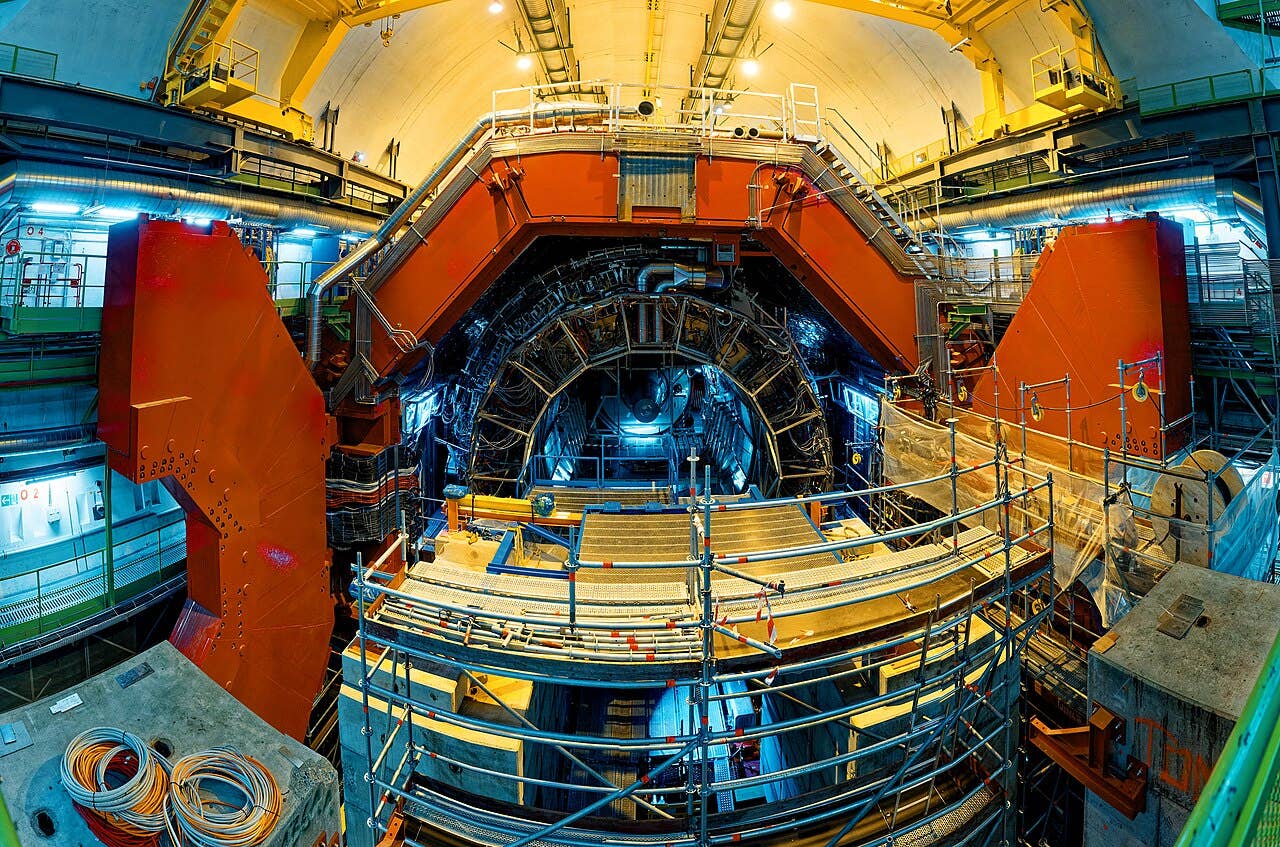
The ALICE experiment at CERN’s Large Hadron Collider. CERN data reveal evidence for gluon saturation inside atomic nuclei and challenge a competing nuclear shadowing model. (CREDIT: CERN)
- CERN’s ALICE experiment found that gluons behave differently at the smallest scales inside lead nuclei, favoring gluon saturation over a competing shadowing explanation.
- By measuring J/ψ particle production across different energies and spatial scales, physicists could distinguish models that previously produced similar predictions.
- The result gives scientists a sharper tool for studying how gluons organize inside nuclei, although more high-energy data are needed to test saturation models more precisely.
Gluons, the particles that bind quarks together, may behave very differently inside atomic nuclei depending on how closely scientists look. New CERN measurements now separate two competing explanations that had long produced similar predictions.
The ALICE experiment at CERN’s Large Hadron Collider measured incoherent J/ψ photonuclear production across several energies and spatial scales. The work provides the first multidimensional measurement of the process as a function of both interaction energy and momentum transfer.
Daniel Tapia Takaki, a University of Kansas professor of physics and astronomy and ALICE member, played a leading role. He worked closely with Czech Technical University investigators.
“Although quarks are often described as the fundamental building blocks of matter, nearly all the mass of the visible universe — from the atoms in our bodies to the matter inside stars — actually comes from the energy carried by gluons and the strong force that binds quarks together,” Tapia Takaki said. “Understanding how gluons behave inside nuclei is therefore essential to understanding how matter itself acquires its mass and structure.”
Turning lead nuclei into a gluon microscope
The measurements used data collected during Run 2 of the Large Hadron Collider, when fast-moving lead nuclei passed near each other without directly colliding. Their electromagnetic fields acted like beams of high-energy photons.
When one of those photons struck another nucleus, it could briefly produce a J/ψ particle.
Unlike measurements that average over an entire nucleus, incoherent J/ψ production can reveal local fluctuations in gluon density. That gives physicists access to structures smaller than a proton.
“Our experiments using incoherent production is like switching from a blurry image to a high-resolution microscope,” Tapia Takaki said. “This process allows us to see how gluons fluctuate and organize themselves inside nuclei. By varying the momentum transfer, our experiment effectively changes the focus of our microscope. At resolutions of 0.6, 0.3 and 0.2 femtometers, ALICE progressively probed smaller regions inside the nucleus. The finest resolution corresponds to structures only about one-quarter the size of a proton.”
If a nucleus were the size of a football stadium, he said, the finest measurement could distinguish details only a few yards across.
A growth pattern begins to flatten
The team measured incoherent J/ψ production from photon-nucleus energies of 20 to 633 billion electron volts. At lower momentum transfer, the production cross section rose visibly as energy increased. The rise was softer at intermediate momentum transfer.
At the highest momentum-transfer range, however, the pattern changed. The cross section initially increased with energy, reached a maximum and then stopped growing at the highest energy.
Momentum transfer is linked to the spatial scale being examined. A value of 0.1 GeV² corresponds to structures about 0.6 femtometers across, while 1.0 GeV² probes scales near 0.2 femtometers.
At the highest energies and momentum transfers, the normalized ratio of cross sections was 0.52 ± 0.13. That differed from unity by more than three standard deviations.
“The results revealed a striking pattern,” Tapia Takaki said. “At the smallest spatial scales explored in the experiment, the production rate of J/ψ particles is significantly suppressed, with a statistical significance of about three standard deviations.”
Shadowing and saturation split apart
That suppression matters because two theoretical frameworks have long competed to explain how gluon density changes inside heavy nuclei.
One is nuclear shadowing. In that picture, multiple interactions inside the nucleus reduce the probability of some particle-production processes.
“In that framework, gluons inside a nucleus partially overlap and obscure each other — similar to layers of clouds blocking sunlight — reducing the probability of certain particle production processes,” Tapia Takaki said.
The other framework is gluon saturation. Quantum chromodynamics, the theory of the strong force, predicts that at very high gluon densities, gluon splitting and recombination can reach a dynamic balance.
“Instead, the observations are consistent with a different phenomenon known as ‘gluon saturation,’ predicted by the theory of quantum chromodynamics, which describes the strong force,” Tapia Takaki said. “In this regime, gluons become so densely packed that they begin interacting strongly with one another, limiting how many can exist in a given region.”
Previous coherent J/ψ measurements could be described by either saturation or shadowing models. The multidimensional measurement changed that.
Above 100 GeV, the leading twist approximation shadowing model disagreed with the new incoherent data by more than three standard deviations in the lower momentum-transfer ranges and more than four in the highest range.
Two saturation-based models came closer. Predictions from Cepila and colleagues and Mäntysaari and colleagues stayed generally within about two standard deviations of the measurements, although one high-momentum-transfer comparison reached roughly 2.5 standard deviations.
Small scales point toward collective gluon behavior
The energy-dependent hot-spot model offers one picture of what may be happening. It treats gluons as concentrated in localized regions whose number and positions change with energy.
At high energy, those regions can overlap. In the model, that reduces differences among possible gluon configurations, causing incoherent production to decrease at small spatial scales as saturation is approached.
“At these extraordinary scales, we observe evidence that the gluons begin to behave collectively, a phenomenon known as gluon saturation,” Tapia Takaki said.
The study does not close the question. More data at high energies and large momentum transfer would help determine what drives the suppression. Recent theoretical work also suggests saturation models may need additional sources of quantum fluctuations.
Practical implications of the research
The measurement gives physicists a new way to test competing descriptions of gluons inside heavy nuclei. By tracking energy and spatial scale together, ALICE can expose differences that disappear when either variable is studied alone.
The current shadowing implementation is disfavored by the data, while saturation-based models better reproduce the observed energy dependence. That makes incoherent J/ψ production a useful probe for future tests of high-density gluon behavior.
More precise measurements in the high-energy, small-scale region could help refine how quantum fluctuations are treated and clarify when gluons begin acting collectively inside nuclei.
Dig deeper into gluon saturation and nuclear structure
These five resources extend the story into the newest experimental and theoretical work on gluon saturation, nuclear gluon imaging and J/ψ production. Together, they show how CERN measurements connect with other LHC results and the future Electron-Ion Collider.
- CMS probes fluctuating gluon fields with incoherent J/ψ production
The CMS Collaboration measured incoherent J/ψ photoproduction across photon-nucleon energies of roughly 40 to 400 GeV, probing gluons carrying extremely small fractions of a nucleon’s momentum. (CMS Collaboration / arXiv) - Nuclear structure and saturation effects from diffractive vector meson production
This May 2026 analysis examines coherent and incoherent vector-meson production across different nuclei. (arXiv) - Observation of nuclear suppression in coherent Upsilon photoproduction
This 2026 work uses another heavy quarkonium state, the Upsilon, to investigate gluons in dense nuclear environments. (arXiv) - When JIMWLK evolution really matters
This 2026 Physical Review D paper examines JIMWLK evolution, one of the theoretical tools used to describe high-energy gluon fields in the saturation regime. (Physical Review D) - The Electron-Ion Collider’s next chapter for gluon saturation
Brookhaven National Laboratory explains how decades of measurements at RHIC and the LHC are feeding into the Electron-Ion Collider, where gluon saturation and three-dimensional imaging of nucleons will be major research targets. (Brookhaven National Laboratory)
Research findings are available online in the journal Physical Review Letters.
The original story "Tiny structures inside lead nuclei expose a new pattern in gluon behavior" is published in The Brighter Side of News.
Related Stories
- Scientists achieve the impossible by creating matter from empty space
- For the first time ever, scientists create particles out of empty space
- SPhysicists achieve most accurate measurement yet of the W boson
Like these kind of feel good stories? Get The Brighter Side of News' newsletter.
Joshua Shavit
Writer and Editor
Joshua Shavit is a NorCal-based science and technology writer with a passion for exploring the breakthroughs shaping the future. As a co-founder of The Brighter Side of News, he focuses on positive and transformative advancements in technology, physics, engineering, robotics, and astronomy. Having published articles on AOL.com, MSN, Yahoo News, and Ground News, Joshua's work highlights the innovators behind the ideas, bringing readers closer to the people driving progress.