Sweat may cool the body less than expected in hot, dry and windless conditions
Sweat evaporation heat risk may rise in hot, dry, windless air when competing air currents slow the body’s cooling.
 Arizona State University Writer: Joseph Rojas

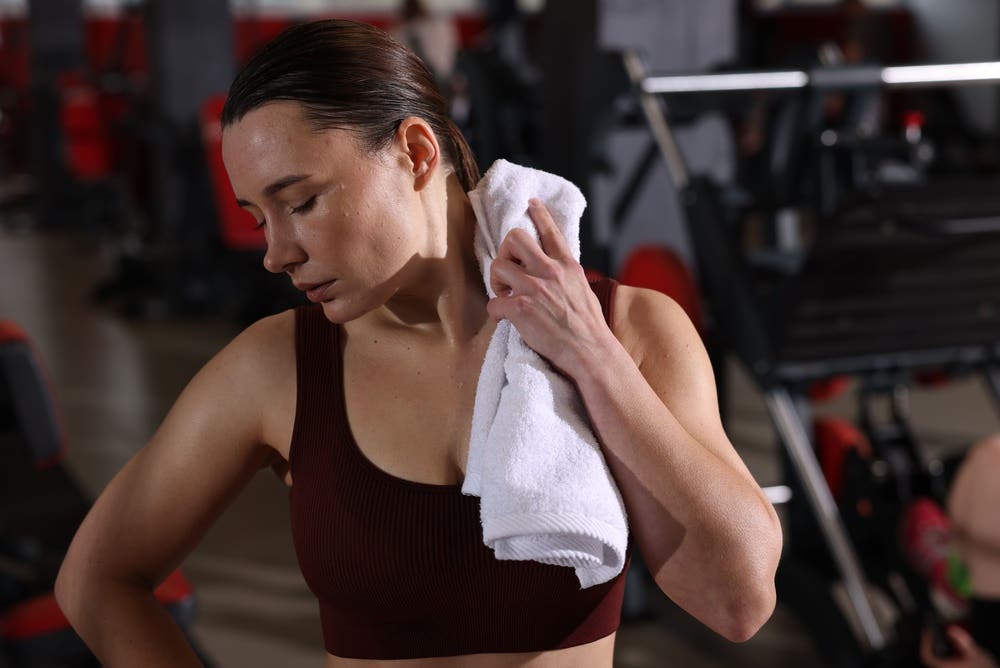
ASU researchers found a hidden airflow effect that can cut sweat evaporation by more than 50% in still heat. (CREDIT: Shutterstock)
- Sweat may cool the body less effectively in hot, dry and windless conditions than many heat models assume.
- In still air, heat-driven and humidity-driven air currents near the skin can cancel each other, slowing sweat evaporation.
- The finding could improve heat-safety models for tents, unfinished buildings, homes without cooling and other low-airflow spaces.
Sweat can pour off the skin and still fail to cool as expected. In very hot, dry and windless air, the body’s main cooling system may run into a hidden physics problem.
That problem involves the tiny layer of air next to the skin. A study from Arizona State University found that competing air movements near sweaty skin can sharply reduce evaporation, especially when temperatures climb above skin temperature and air barely moves.
The work was led by Konrad Rykaczewski, an associate professor of engineering at Arizona State University, with first author Shri Viswanathan and eight other ASU researchers.
“It turns out that the impact is huge,” Rykaczewski said. “It can change how much sweat evaporates from your skin by over 50 percent.”
When sweat meets still desert air
Sweating cools the body when liquid water on the skin evaporates into water vapor. Air movement helps by carrying that vapor away. That is why even a light breeze or fan can make heat feel more bearable.
The ASU team focused on what happens when there is little or no wind.
When outside air is hotter than skin, the air next to the body cools. Cooler air becomes denser and tends to drift downward. But sweat adds moisture, and humid air is lighter than dry air. That moisture-driven effect pushes air upward.
In hot, dry and still conditions, those two forces can oppose each other. Around 105 degrees Fahrenheit with low humidity and no wind, the currents can nearly cancel out. The air near the skin then becomes stagnant, leaving sweat vapor with fewer ways to escape.
“This is really important for indoor settings or places with very little air movement,” Rykaczewski said. “Think about a tent, or a partially enclosed worksite or an unfinished building.”
A sweating manikin takes the heat
The researchers did not place volunteers in extreme conditions. They used ANDI, a customized sweating thermal manikin.
ANDI contains sensors that measure heat loss and heat gain. It also has pores that drip simulated sweat as heat rises. That allowed the team to study sweating without exposing people to risky temperatures.
The researchers placed the manikin in controlled conditions and measured how heat and moisture moved away from the body. They also built computer models and ran about 100 sweating simulations across many temperature and humidity combinations.
“There are multiple heat-transfer pathways involved, so isolating each one, making sure we could replicate it computationally, and then combining them all into one model took a tremendous amount of effort,” Rykaczewski said.
The setup helped the team test a process familiar in engineering but rarely applied to human sweating. Engineers who study heat exchange in electronics know that temperature and moisture can change air buoyancy. In human heat-balance models, that humidity-driven effect has often gone missing.
The omission matters most when air barely moves. In those settings, buoyancy, not wind, controls much of the airflow near the body.
A missing term in heat-risk models
Common human heat-balance models often estimate cooling from the difference between air temperature and skin temperature. They do not fully account for how sweat vapor changes air density near the skin.
The ASU simulations showed that this can lead to large errors. In one two-hour heat exposure, ignoring humidity-driven buoyancy underpredicted the rise in core body temperature by nearly 2 degrees Fahrenheit for a person at rest in still air.
That gap could matter for people sheltering indoors, resting in tents or working in partly enclosed places during extreme heat. A model that assumes too much evaporation may underestimate how quickly the body stores heat.
The study also found that the direction of the error depends on conditions. When temperature-driven and humidity-driven buoyancy reinforce each other, sweat evaporation can increase. When they fight each other, evaporation can drop sharply.
In other words, sweat is not a simple cooling guarantee. Its effectiveness depends on the air’s temperature, humidity and motion close to the body.
A mystery that began in hot rooms
The question of sweat cooling reaches back centuries. In 1775, English physician Charles Brian Blagden and several companions spent time in rooms heated to more than 230 degrees Fahrenheit. The rooms were hot enough to cook raw meat placed inside them.
Blagden observed that human core body temperature stayed nearly constant while sweat poured out and evaporated. That helped show how powerful perspiration could be.
The science has advanced since then, but Rykaczewski said important questions remain. His team has also studied how sweat appears and spreads over skin.
In earlier work, volunteers wore a body suit lined with tubes that circulated hot or cold water. The researchers observed sweat saturating the skin’s outer layer, collecting in shallow pools around pores and spreading into a thin film. After the first round evaporated, salt residue helped later sweat spread faster.
That thin film may expose more sweat to air and improve evaporation. But the new study shows that air behavior above the skin can still limit cooling.
Fans, fabrics and future heat protection
The new findings point toward practical questions about airflow and clothing. The ASU team is studying when sweat clings to the body and evaporates, and when it runs or drips away before cooling can happen.
“The bigger question is how you manage that sweat and what kinds of materials you can put next to the skin to optimize cooling,” Rykaczewski said.
Clothing can change the small environment between skin and fabric. Hair, sweat-gland density and skin structure also vary across the body. Those differences may affect how sweat spreads and evaporates.
The researchers are planning studies of interactions between skin, sweat and clothing textiles. They see opportunities to improve clothing design so materials help manage sweat more effectively.
They are also conducting field studies across Arizona. Those studies measure how different populations experience and respond to extreme heat using environmental sensing platforms and improved models of sweat evaporation and thermoregulation.
Practical implications of the research
The findings could help improve heat-stress models used for workers, first responders, soldiers, athletes and people sheltering from dangerous heat. Current models may miss risk in hot, dry and low-airflow spaces.
Better accounting for humidity-driven buoyancy could guide safer building design, heat adaptation measures and cooling recommendations. It may also clarify when even small air movement from fans, vents or openings can help sweat evaporate more effectively.
The work does not mean sweating stops working in heat. It shows that sweating depends on physics outside the body as well as physiology inside it. In tents, unfinished buildings, indoor rooms without cooling and other stagnant spaces, that distinction can affect how quickly heat strain builds.
“It’s funny because it’s kind of an icky topic but it’s also fascinating,” Rykaczewski said. “You can spend your entire career doing highly specialized research that only twenty experts care about. But not sweating because everybody sweats.”
Dig deeper into sweat evaporation, airflow and human heat stress
These resources explore how sweat removes heat, how airflow and humidity alter cooling, and how extreme environments, fans and personal cooling strategies affect human heat strain.
Sweat evaporation in humans: A molecular and thermodynamic perspective
This review explains sweat evaporation from molecular and thermodynamic principles, including how airflow, humidity, clothing and skin conditions determine whether perspiration actually removes body heat. (Experimental Physiology, 2026)
Examining the physiological strain with electric fans during high indoor heat stress
In controlled indoor heat exposures, researchers found fans improved evaporative efficiency but increased physiological strain once temperatures exceeded about 43°C in healthy young adults, illustrating the tradeoff between evaporation and convective heat gain. (Building and Environment, 2025)
Evaluating low-energy cooling strategies on thermal and cardiac strain in older adults exposed to very hot and dry heat with accompanying activities of daily living
Researchers exposed older adults to 47°C dry heat and found that skin wetting reduced core temperature and cardiovascular strain, while fan use increased body heating, highlighting how cooling strategies depend strongly on environmental conditions. (Journal of Applied Physiology, 2025)
Practical Considerations for Using Personal Cooling Garments for Heat Stress Management in Physically Demanding Occupations: A Systematic Review and Meta-Analysis Using Realist Evaluation
This systematic review and meta-analysis of 33 studies examined cooling garments used during physical work in hot environments, finding that conductive and hybrid systems generally produced the most consistent reductions in core temperature and heart rate. (American Journal of Industrial Medicine, 2025)
Critical environmental core temperature limits and heart rate thresholds across the adult age span (PSU HEAT Project)
This study exposed young, middle-aged and older adults to progressively hotter humid and dry environments to identify conditions where the body can no longer maintain stable core temperature, providing important context for modeling human heat limits. (Journal of Applied Physiology, 2024)
Research findings are available online in the journal Science Advances.
The original story "Sweat may cool the body less than expected in hot, dry and windless conditions" is published in The Brighter Side of News.
Related Stories
- Sweating may naturally suppress hunger, scientists find
- Sweat-powered sensor converts any cup into a portable health monitoring system
- Innovative finger wrap uses sweat to provide health monitoring
Like these kind of feel good stories? Get The Brighter Side of News' newsletter.
Rebecca Shavit
Writer
Based in Los Angeles, Rebecca Shavit is a dedicated science and technology journalist who writes for The Brighter Side of News, an online publication committed to highlighting positive and transformative stories from around the world. Having published articles on MSN, AOL News, and Yahoo News, Rebecca's reporting spans a wide range of topics, from cutting-edge medical breakthroughs to historical discoveries and innovations. With a keen ability to translate complex concepts into engaging and accessible stories, she makes science and innovation relatable to a broad audience.