Mars orbiter finds hidden volcanic activity near Alba Mons
Hydrogen chloride near Alba Mons may point to dormant volcanism on Mars, with seasonal ice helping release gas from a possible source beneath the surface.

 Editor: Joshua Shavit

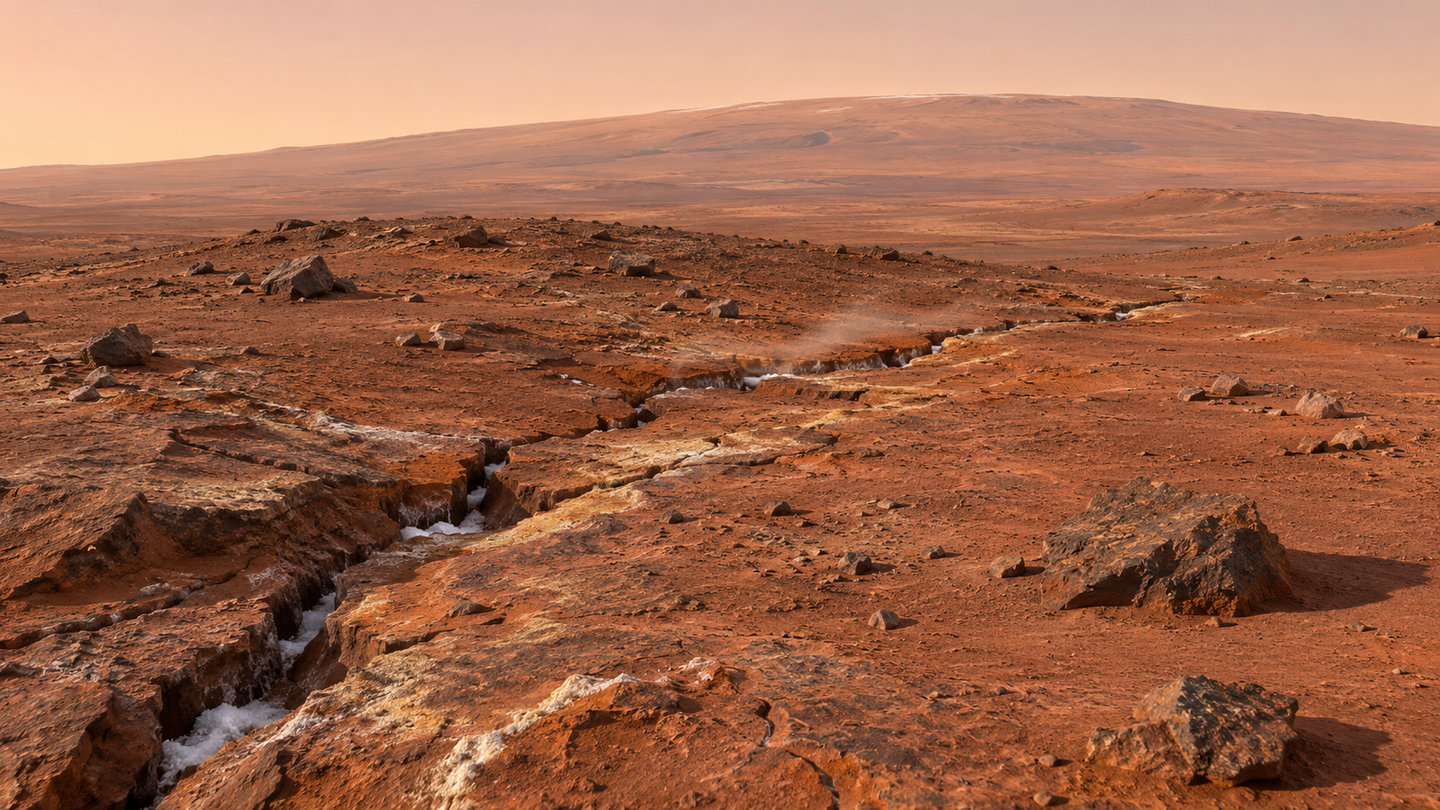
Artist’s impression of frost-lined fissures near Mars’ Alba Mons volcano. Localized hydrogen chloride detections suggest possible gas seepage from a dormant volcanic system, although individual vents remain unconfirmed. (CREDIT: The Brighter Side of News)
- Hydrogen chloride detected near Alba Mons during early northern summer points to a possible localized source beneath Mars’ surface.
- Orbital measurements and images of narrow fissures support a volcanic explanation, but do not identify individual gas vents.
- The findings suggest dormant magmatic activity could persist, without establishing a current eruption, liquid water or life.
An unexpected gas signal above northern Mars has raised a question about what remains warm beneath its frozen ground. Hydrogen chloride appeared near Alba Mons during a season when the gas usually becomes difficult to detect. Its concentration near this volcanic region suggests that a source below the surface may be contributing to the atmosphere.
An international team led by Alexander Trokhimovskiy reports the findings in Science Advances. The researchers combined atmospheric observations with detailed images of fractures and ridges. Their preferred explanation involves dormant volcanism on Mars, with gases interacting with ice before reaching the air.
“Our findings suggest that Mars has retained enough internal heat to support volcanic activity until recently, and possibly still does,” said co-lead author Daniel Mège, a professor at the Space Research Centre of the Polish Academy of Sciences. The evidence supports that possibility without establishing an active eruption. Neither fresh lava nor a definite local heat anomaly accompanied the gas detections.
A gas appearing out of season
Hydrogen chloride, or HCl, contains hydrogen and chlorine. On Earth, volcanic vents can release it, making the compound an interesting target for planetary scientists. Its presence alone, however, does not establish that magma is responsible, since other chemical processes can produce it. The scientific question is therefore not simply whether HCl exists, but whether its location, timing and surrounding geology require an explanation beyond the usual atmospheric cycle.
Mars has a pronounced seasonal HCl cycle linked to dust, water and temperature. The gas generally becomes widespread during southern spring and summer, when warmer conditions and increased dust activity help atmospheric chemistry proceed. Concentrations can reach roughly four to five parts per billion before declining again.
The Alba Mons detections occurred during early northern summer, closer to the colder part of Mars’ orbit. That timing matters because existing explanations for the widespread seasonal gas do not reproduce this localized pattern. The team therefore investigated whether something different was supplying chlorine in this particular region.
The distinction separates a planetary chemical cycle from a potential local geological source. The researchers are not arguing that every HCl detection comes straight from a volcano. Instead, they suggest that small underground sources could contribute chlorine that later moves among the atmosphere, surface salts and ice.
Reading traces in the atmosphere
The measurements came from the Atmospheric Chemistry Suite aboard the ExoMars Trace Gas Orbiter. Its infrared instruments examine sunlight passing through the Martian atmosphere during solar occultations. Different molecules absorb particular wavelengths, allowing researchers to identify tiny quantities of gas from their spectral signatures.
Across two Martian years, the relevant northern-summer observations included 78 occultations. Eight showed clear HCl signatures within a narrow longitude range near Alba Mons. An initial pair of limited observations prompted a dedicated search in a later Martian year, which produced six additional detections.
The gas remained concentrated in the lowest atmospheric layers, with a steep change in abundance through the first 10 kilometers. Maximum concentrations reached about 1.5 parts per billion. Other measurements, including some around Alba Mons, yielded only upper limits, showing that the signal was intermittent rather than continuously visible.
That distribution is important because rapidly removed gas cannot easily spread around the planet. The team suggests that ice particles help remove HCl from the air, limiting its atmospheric lifetime. A short lifetime would help explain why an intermittent source could remain geographically distinct in the observations.
Fissures offer a possible route upward
The atmospheric pattern led researchers to examine the terrain beneath the detections. They used images from TGO’s Colour and Stereo Surface Imaging System, or CaSSIS, and NASA’s HiRISE camera. These revealed narrow fissures associated with ridges and broader structures linked to the region’s volcanic history.
Some fissures appear only tens of centimeters wide, while groups of fractures extend much farther across the landscape. Certain ridges have bright or dark surrounding patches that could reflect deposited material. The researchers interpret these features as possible pathways for gas moving through the crust, not direct images of gas escaping.
The fissures cut an ice-rich surface covering estimated to be about 630,000 years old. Their narrowness also suggests they would become obscured without relatively recent formation or continued maintenance. Dust accumulation and seasonal changes in frozen ground would otherwise tend to alter or cover such small features.
Crucially, the team searched for landforms compatible with seepage, rather than identifying the actual vents responsible for individual detections. High-resolution image coverage is uneven, and the connection remains interpretive. The proposed magmatic system lies beneath the surface, beyond what these cameras can directly inspect.
How ice could regulate the release
The proposed mechanism involves more than gas rising through an open crack. Chlorine-bearing material could interact with subsurface ice and remain stored before entering the atmosphere. Seasonal warming could then release HCl as ice sublimates, changing directly from a solid into gas.
This makes the frozen ground a possible temporary reservoir rather than simply a lid. Gas might escape directly from fractures or undergo chemical processing in permafrost and chlorine-bearing salts first. The detected molecules therefore need not have traveled unchanged from magma into the instrument’s view.
The researchers considered alternatives, including mud volcanism and the breakdown of perchlorates, salts containing chlorine and oxygen. Those processes may occur widely across the northern lowlands. By themselves, the team argues, they do not explain why the unusual detections cluster near Alba Mons.
A local magmatic source consequently offers the team’s best explanation, but the underground system has not been directly observed. Previous marsquakes and young volcanic landforms provide broader reasons to investigate retained internal heat. They do not independently identify the source of this particular gas signal.
What dormant volcanism on Mars could mean for life
Heat beneath the crust could matter beyond explaining atmospheric chemistry. If magma encounters groundwater, it could support hydrothermal systems, environments where heated water interacts with rock. Such settings could potentially provide energy and shelter for microorganisms, if suitable conditions actually exist.
Mège said the fissures would make sensible targets for investigating Martian life if active hydrothermal systems are present. That possibility remains several steps beyond the observations. Hydrogen chloride is not a detection of life, and the study does not demonstrate liquid water or a habitable environment beneath Alba Mons.
Testing dormant volcanism on Mars requires determining whether the localized seasonal signal persists and whether similar patterns appear elsewhere. The researchers propose continued searches around Tharsis and Cerberus, regions already associated with relatively recent activity. Comparing those observations with atmospheric models could help distinguish a recurring underground source from other processes.
Additional detections near Alba Mons occurred during another northern summer, although detailed analysis will be reported separately. Further observations can test how consistently the gas returns and how its distribution changes. Establishing the connection between that recurring atmospheric trace and a specific underground source remains the central challenge.
Dig deeper into Mars’ hidden activity
These resources explore atmospheric chemistry, buried water and evidence for continuing geological activity.
An unusual dust storm reveals how Mars lost some of its water
Explains how unusual northern-summer weather can change the movement of water through the atmosphere. (European Space Agency, February 2026)
Evidence of rapid hydrogen chloride uptake on water ice in the atmosphere of Mars
Examines how ice particles can rapidly remove hydrogen chloride, helping explain its changing abundance. (Icarus, 2024)
Geophysical evidence for an active mantle plume underneath Elysium Planitia on Mars
Uses observations and modeling to investigate a possible internal heat source in another Martian region. (Nature Astronomy, December 2022)
ExoMars discovers hidden water in Mars’ Grand Canyon
Describes how a different TGO instrument maps hydrogen associated with material beneath the surface. (European Space Agency, December 2021)
Transient HCl in the atmosphere of Mars
The original detection paper explains the widespread seasonal hydrogen chloride signal that preceded the Alba Mons investigation. (Science Advances, February 2021)
Research findings are available online in the journal Science Advances.
The original story "Mars orbiter finds hidden volcanic activity near Alba Mons" is published in The Brighter Side of News.
Related Stories
- Astronomers discover a giant volcano on Mars that may hide the remnants of an ice glacier
- NASA finds a surprisingly complex history of water on ancient Mars
- Mars's mantle may be hundreds of degrees hotter beneath one hemisphere
Like these kind of feel good stories? Get The Brighter Side of News' newsletter.
Joseph Shavit
Writer, Editor-At-Large and Publisher
Joseph Shavit, based in Los Angeles, is a seasoned science journalist, editor and co-founder of The Brighter Side of News, where he transforms complex discoveries into clear, engaging stories for general readers. With vast experience at major media companies like The Los Angeles Times, Times Mirror and Tribune Publishing, he writes with both authority and curiosity. His writing focuses on space science, planetary science, quantum mechanics, geology. Known for linking breakthroughs to real-world markets, he highlights how research transitions into products and industries that shape daily life.