Mars’s longest morning cloud may form ice without dust
Extreme cooling near Arsia Mons may let water vapor form ice particles directly, helping explain Mars’s striking morning cloud.
 ESA Writer: Nicole Shearer

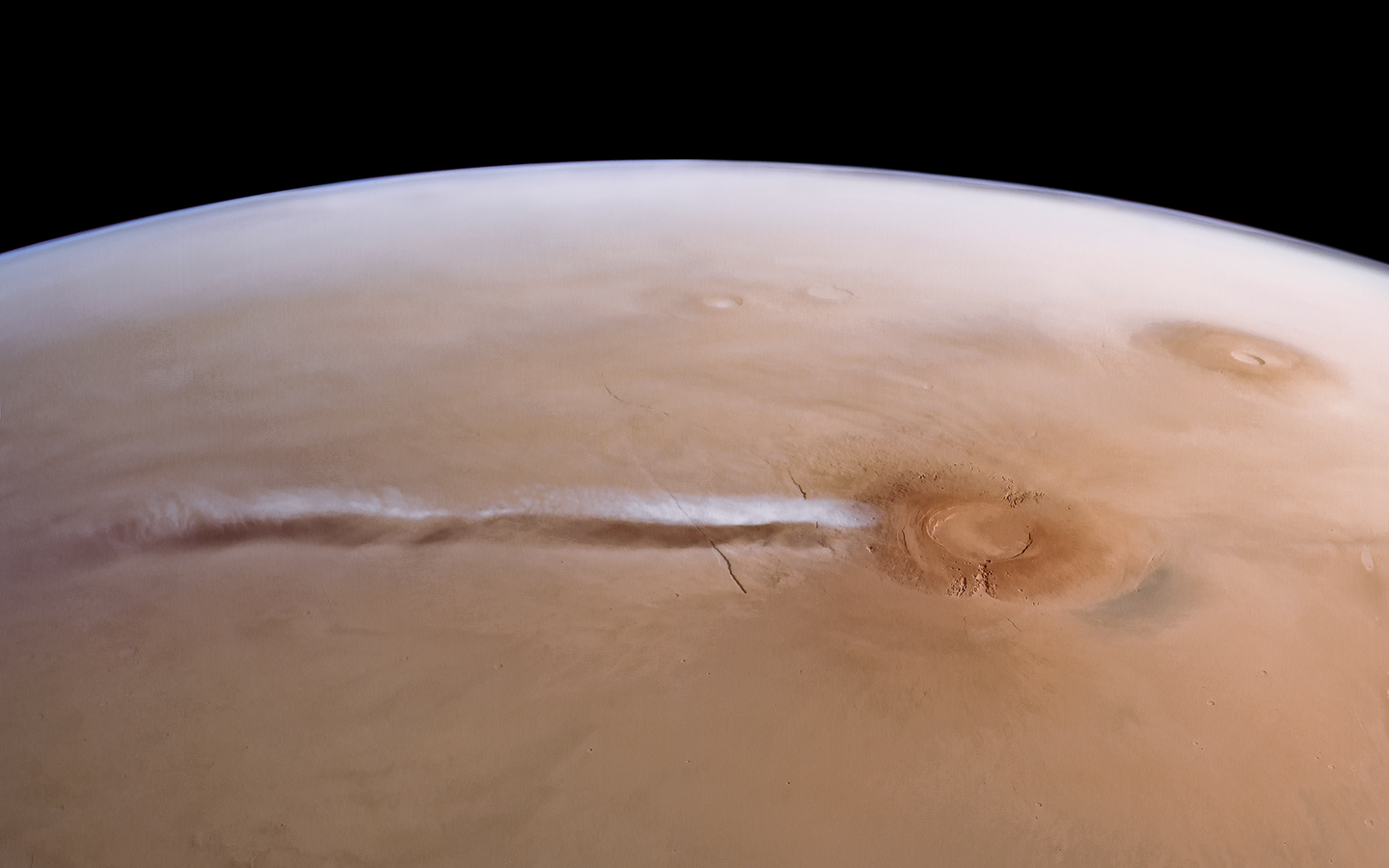
The Arsia Mons Elongated Cloud as seen by Mars Express. A new model suggests Mars’s 1,800-kilometer cloud forms ice without dust seeds, though the mechanism still needs confirmation. (CREDIT: ESA)
- A new model suggests Mars’s Arsia Mons Elongated Cloud forms partly through ice nucleation without dust seeds.
- Rapid cooling near the volcano could produce extreme supersaturation, creating particles that winds stretch into a long cloud.
- The simulations reproduce key features, but important mismatches remain and the proposed mechanism needs observational confirmation.
A white cloud stretching as far as 1,800 kilometers across Mars may owe its extraordinary shape to an unusual way of making ice. Computer simulations suggest water vapor can form new ice particles without first attaching to dust.
The finding concerns the Arsia Mons Elongated Cloud, a recurring morning feature downwind of one of Mars’s giant volcanoes. Jorge Hernández-Bernal of LMD/CNRS/Sorbonne Université in Paris led the modeling study, published in Nature Geoscience.
Using observations from the European Space Agency’s Mars Express, the team investigated why conventional cloud models failed to reproduce the long tail. Adding a process called homogeneous ice nucleation produced the cloud’s defining features, although several measurements still differed substantially.
The results offer a physical explanation for a familiar orbital spectacle. They do not yet constitute direct observational confirmation of the proposed particle-forming process.
A cloud that grows and disappears each morning
The elongated cloud develops during southern spring and summer, within Mars’s dusty season. It begins near sunrise on the western side of Arsia Mons, a volcano approximately 20 kilometers tall.
Water-ice particles form a cloud at roughly 45 kilometers altitude. Winds carry those particles westward, extending the cloud over about three hours before it detaches from the volcano and eventually disappears.
At its longest, the white plume spans nearly twice the length of the United Kingdom. The daily cycle repeats for several months, making it both spectacular and predictable enough for repeated study.
Despite its appearance beside a volcano, the cloud is an atmospheric phenomenon. Researchers classify it as an orographic cloud, meaning that terrain influences the airflow responsible for its formation.
Mars Express drew attention to the cloud in 2018 and has monitored it repeatedly since. Earlier research examined its life cycle and the atmospheric waves generated around Arsia Mons, but explaining its elongated tail remained difficult.
The new work used observations from the spacecraft’s Visual Monitoring Camera, High Resolution Stereo Camera and OMEGA instrument. Those measurements provided a basis for comparing the modeled cloud with its observed appearance and evolution.
Making ice without a dust particle
Cloud particles commonly begin forming on existing material suspended in the atmosphere. On Mars, dust supplies those starting points through a process called heterogeneous nucleation.
Homogeneous nucleation takes a different route. New ice particles form directly from water vapor without requiring a pre-existing particle as a seed.
Both pathways involve vapor becoming ice under the low pressures relevant to Martian clouds. The difference is whether another material provides the surface on which ice formation begins.
“For the AMEC, it seems that cloud formation takes place without needing any of this ‘stuff’,” Hernández-Bernal said. AMEC is the abbreviation researchers use for the Arsia Mons Elongated Cloud.
The proposed mechanism does not require an atmosphere entirely free of dust. Instead, rapid cooling and a low local concentration of dust can allow conditions to develop faster than ordinary dust-assisted cloud formation removes excess vapor.
Scientists have previously explored direct ice nucleation from vapor as a possibility in the upper atmospheres of Earth and Venus. The Mars study argues that the elongated cloud provides strong model-based evidence for this pathway in a planetary atmosphere.
A mountain wave creates an extreme cold pocket
The researchers combined a regional atmospheric model with calculations tracking cloud microphysics. Their simulations first reproduced the effect of Arsia Mons on passing air, even when conventional dust-assisted nucleation failed to create the observed tail.
The volcano generates atmospheric gravity waves, producing a compact pocket of especially cold air on its western slope. Air parcels approaching that pocket rise several kilometers and cool rapidly as they expand.
In the model, cooling reaches about 0.05 kelvin per second over 800 seconds. That corresponds to approximately 40 degrees of cooling in a little over 13 minutes, with final temperatures below 130 kelvin.
The cooling drives the modeled saturation ratio relative to ice to around 100,000. This ratio compares the amount of water vapor present with the amount corresponding to saturation at that temperature.
It does not mean the air contains 100,000 times more water than everyday air on Earth. The exceptionally low temperature sharply reduces the saturation threshold, allowing a large ratio even in Mars’s thin atmosphere.
Under these conditions, the particle calculations generate hundreds of ice particles per cubic centimeter. Westward winds then transport that dense population away from the cold pocket, creating the elongated cloud.
Why the tail survives, and where the model falls short
The model explains the cloud’s contrast with its surroundings through particle abundance. Newly created particles let excess vapor become ice efficiently along the tail, while nearby air with fewer particles produces thinner haze.
As the cold pocket weakens later in the morning, homogeneous nucleation stops. The modeled cloud head shrinks and the tail detaches, matching the sequence observed from orbit.
Variations in the temperature field also produce changes in particle growth and shrinkage. These help reproduce a narrow neck behind the cloud head and differences in brightness along the tail.
However, the match is incomplete. The simulated cloud is 30–50% narrower than observed, begins approximately 1.5 hours late and reaches only about 25% of the observed maximum length before detachment.
The authors suggest delayed formation, slower modeled winds and particle loss in a warm region may explain the short tail. The modeled particle size and optical depth, a measure of light attenuation, are consistent with observations.
They also tested thousands of scenarios involving smaller particles that might support dust-assisted ice formation. Scenarios that generated a suitable tail also produced surrounding hazes inconsistent with observations, weakening that alternative explanation.
A promising explanation still needs a test
The study’s conclusion rests on simulations compared with spacecraft observations. Its authors explicitly state that confirming homogeneous nucleation in the cloud will require further detailed observations and modeling.
Future work must also establish whether the process occurs in other Martian clouds. Its possible importance to the planet’s wider water cycle remains an open question.
Mars Express is useful because it can observe the morning hours when the cloud develops. Tracking changes over hours helps researchers investigate phenomena that disappear before other observations can capture them.
The model gives scientists a specific mechanism to examine, with predictions about cooling, particle abundance and cloud evolution. Whether similar conditions produce comparable clouds elsewhere will require evidence from those environments.
Dig deeper into Martian clouds and ice formation
These resources explore the cloud’s daily behavior, atmospheric modeling and the conditions that allow water vapor to form ice.
An Extremely Elongated Cloud Over Arsia Mons Volcano on Mars: I. Life Cycle: Spacecraft observations document the cloud’s recurring formation, rapid expansion and disappearance. (Journal of Geophysical Research: Planets, 2021)
An Extremely Elongated Cloud Over Arsia Mons Volcano on Mars: 2. Mesoscale Modeling: Earlier simulations investigate how the volcano drives atmospheric waves and cooling near the cloud’s origin. (Journal of Geophysical Research: Planets, 2022)
Evidence of Water Vapor in Excess of Saturation in the Atmosphere of Mars: Mars Express observations establish that supersaturated water vapor can occur in the Martian atmosphere. (Science, 2011)
Homogeneous nucleation of amorphous solid water particles in the upper mesosphere: This foundational modeling study examines competition between ice formation with and without atmospheric particle seeds. (Journal of Atmospheric and Solar-Terrestrial Physics, 2010)
Ephemeral Ice Clouds in the Upper Mesosphere of Venus: Modeling explores potential ice-cloud formation in Venus’s upper atmosphere, including homogeneous nucleation. (Journal of Geophysical Research: Planets, 2023)
Research findings are available online in the journal Nature Geoscience.
The original story "Mars’s longest morning cloud may form ice without dust" is published in The Brighter Side of News.
Related Stories
- Rainstorms billions of years ago may have created habitable hotspots on Mars
- NASA finds a surprisingly complex history of water on ancient Mars
- Solar storms may alter the weather on Mars, study finds
Like these kind of feel good stories? Get The Brighter Side of News' newsletter.
Joshua Shavit
Writer and Editor
Joshua Shavit is a NorCal-based science and technology writer with a passion for exploring the breakthroughs shaping the future. As a co-founder of The Brighter Side of News, he focuses on positive and transformative advancements in technology, physics, engineering, robotics, and astronomy. Having published articles on AOL.com, MSN, Yahoo News, and Ground News, Joshua's work highlights the innovators behind the ideas, bringing readers closer to the people driving progress.