Evolution has used the same genetic ‘cheat sheet’ for over 120 million years
Butterflies and a moth evolved similar warning wings by reusing the same genes across 120 million years of evolution.

 Edited By: Joseph Shavit

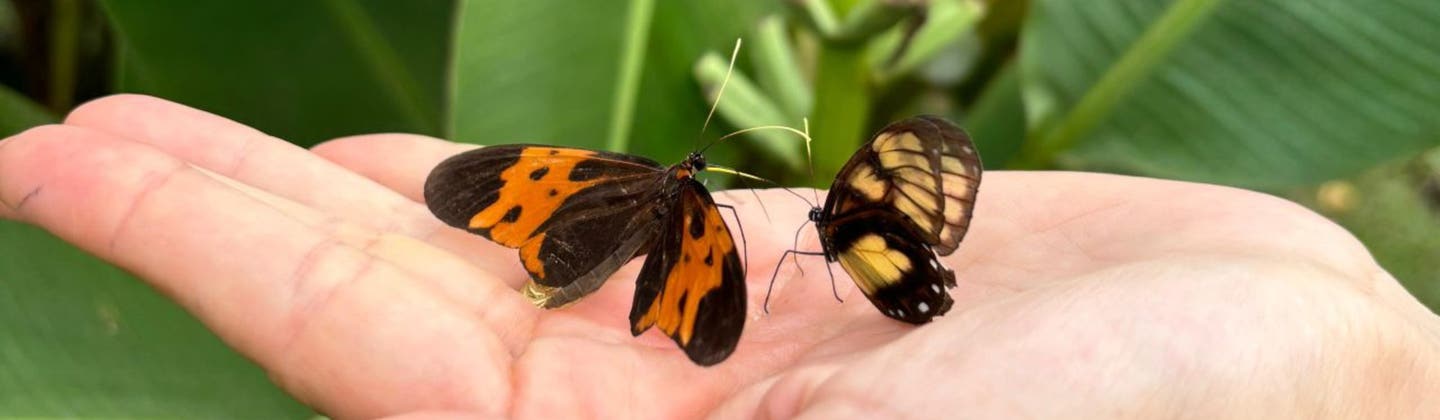
Study finds butterflies and moths reused the same wing-pattern genes for 120 million years, pointing to predictable evolution. (CREDIT: Wikimedia / CC BY-SA 4.0)
A yellow band across a wing might look like a simple flourish. In the South American rainforest, it can mean survival.
Across butterflies and a day-flying moth that split from one another tens of millions of years ago, researchers found that near-identical warning patterns keep arising through the same small set of genes. The result points to something that has long intrigued evolutionary biologists: maybe evolution is not always as open-ended as it seems.
The international team, led by scientists at the University of York and the Wellcome Sanger Institute, examined several distantly related species that belong to the neotropical tiger mimicry ring. These insects share bold wing patterns that warn birds and other predators to stay away. Because the species are toxic or distasteful, looking alike helps them all. If a bird has already learned that a certain pattern means bad news, any species wearing the same signal gains an advantage.
What stood out in the analysis was not just that the wing patterns converged, but that the underlying genetics did too.
Investigating seven butterfly lineages and one moth, the team found that two genes, ivory and optix, repeatedly shaped similar color patterns across lineages that diverged between about 1 million and 120 million years ago. The work was published in PLOS Biology.
“Convergent evolution, where many unrelated species independently evolve the same trait, is common across the tree of life. But we rarely have the opportunity to investigate the genetic basis of this phenomenon,” said Professor Kanchon Dasmahapatra of the University of York’s Department of Biology.
A rainforest warning system with a long memory
The species in this mimicry ring do not simply resemble one another by chance. They live in overlapping areas, and many share one of several recurring pattern types, including orange-black, yellow band, and striped forms. Those patterns act as warning signs.
That makes the group a powerful test case for a basic question in biology: when unrelated species evolve the same trait under similar pressures, do they get there through different genetic routes, or through the same ones?
In this case, the answer leaned strongly toward reuse.
Using whole-genome data from hundreds of wild-caught insects, the researchers traced the forewing yellow band in several ithomiine butterflies to ivory, a long noncoding RNA near the gene cortex. In each species, the most strongly associated DNA changes fell in closely matching stretches within the first intron of ivory. These were not changes to the gene’s protein-coding sequence. Instead, they appeared in regulatory regions, the molecular switches that help control when and where a gene turns on.
The same kind of pattern appeared again with hindwing color. In several butterfly species, black-versus-orange wing patterning mapped to regions upstream of optix, another gene already known to shape wing coloration in Lepidoptera.
Rather than a scattered collection of tiny effects spread across the genome, the study points to a simpler arrangement: a few major switches, used again and again.
The authors argue that this helps settle an old debate over mimicry. More than a century ago, some researchers proposed that major visual changes came from large-effect mutations, while others suggested that mimicry should depend on many small modifiers distributed across the genome. Here, the evidence favored a middle ground tilted toward large-effect loci. The major switches were ivory and optix, and the fine-tuning changes clustered nearby rather than being broadly dispersed.
The same trick, and then the same trick again
One of the strongest examples came from Heliconius pardalinus, a butterfly that joins the tiger mimicry ring but has received less attention than some of its relatives. The team mapped forewing yellow patterning to a region containing ivory and orange patterning to regions that include optix. That echoed what they had already seen in the ithomiine butterflies.
Then came the moth.
In Chetone histrio, which occurs in striped and orange-black forms in Peru, the researchers again found a strong association near ivory. But this time the mechanism involved a large inversion, a chunk of DNA about 1.018 megabases long that had flipped orientation in the genome. The striped form carried the ancestral gene order, while the orange-black form carried the derived inversion in one or two copies.
That was striking because a similar inversion architecture already exists in the butterfly Heliconius numata. In both species, the inversion appears to help preserve combinations of variants that produce coordinated wing patterns.
The parallels ran deep. One breakpoint in the moth inversion closely matched the location of the P1 inversion in H. numata, and the other breakpoint landed within eight genes of the butterfly’s corresponding breakpoint. These lineages diverged about 120 million years ago.
That means the repeatability in this system did not stop at gene reuse. It extended to genomic architecture itself.
As the authors put it, the similarities between C. histrio and H. numata show “striking parallel evolution not only in gene usage but also in genetic architecture, location and dominance of the inversion haplotypes.”
Testing the genes, not just mapping them
The team did more than look for statistical associations.
In Mechanitis messenoides, they used CRISPR-Cas9 to knock out ivory and optix. The results matched the genetic mapping. When ivory was disrupted, black and orange scales turned yellow. When optix was knocked out, orange scales turned black.
They also looked at where ivory was active in developing wing tissue. In yellow-banded M. messenoides, a region lacking ivory expression lined up with the adult yellow band. In orange-black forms, ivory expression appeared across the forewing.
That gave the study functional support, not just correlation.
The researchers also found hints that specific transcription factor binding sites may help control the yellow band switch in M. messenoides. In a roughly 1.5-kilobase interval, five SNPs were fully associated with the phenotype. Four candidate motifs corresponded closely to binding sites for transcription factors expressed in pupal wing discs, including Sox15, Ftz-F1, ttk, and br-Z4.
At the same time, some caution remains. The team did not find clear evidence that ivory was differentially expressed when comparing whole forewing tissues from yellow-banded and nonyellow-banded insects. But they noted that this was not especially surprising. Because the expected expression difference would occupy only about 20 percent of the wing area, using whole forewings likely diluted the signal below detection.
The study also found one notable exception outside the ivory-optix pattern. In Melinaea menophilus, black-versus-orange patterning in the forewing tip was strongly associated with SNPs between the Hox genes Antennapedia and Ultrabithorax, suggesting that not every mimicry-related feature runs through the same two genes.
Predictable, but not perfectly simple
The broader claim here is not that evolution is rigid. It is that some adaptive outcomes may be reached through a limited number of favored routes.
Professor Joana Meier of the Wellcome Sanger Institute said the insects’ shared toxicity helps explain why similar warning colors keep returning. “These distantly related butterflies and the moth are all toxic and distasteful to birds trying to eat them. They look very much alike because if birds have already learned that a specific colour pattern means “do not eat, we are toxic”, it is beneficial for other species to display the same warning colours.”
She added, “Here, we show that these warning colours are particularly ideal as it seems quite easy to evolve these same colour patterns due to the highly conserved genetic basis over 120 million years.”
That does not mean every species is borrowing ready-made solutions from its neighbors. One major part of the work asked whether similar patterns spread through introgression, the movement of adaptive alleles between species through hybridization.
The answer was mostly no.
Although the team detected ongoing genome-wide gene flow among species in several genera, they found little evidence that the key mimicry alleles at ivory and optix were being shared in that way. In most cases, similar phenotypes appeared to arise through independent mutations in regulatory regions rather than through the reuse of the same inherited allele. The one exception was a narrow signal of introgression near optix in Melinaea species sharing melanic hindwing patterns.
Even so, the authors were careful not to overstate that point. They wrote that they “cannot fully rule out allele sharing” because the top SNPs identified in genome-wide association analyses might miss the true causal changes, especially if those changes involve insertions, deletions, or structural variants.
That restraint matters, because it points to the limits of what this dataset can settle.
Practical implications of the research
The work suggests that at least for some traits, evolution may be more constrained and more forecastable than biologists once assumed.
If multiple lineages repeatedly land on the same genes, and even similar regulatory regions, that gives researchers a stronger basis for predicting how organisms might adapt under recurring pressures. In this case, those pressures come from predator learning and mimicry. In other systems, they could involve drought, heat, toxins, or other environmental challenges.
The findings also sharpen a longstanding view of adaptation. In these butterflies and moths, the path to a successful warning pattern was not infinitely flexible. It tended to run through a small number of major loci, with local regulatory changes shaping where pigments appeared on the wing.
That does not make evolution easy to forecast in every case. But it does suggest that when developmental pathways are tightly constrained, life may keep reaching for the same answers.
The study’s central lesson is simple: replaying life’s tape may not produce identical outcomes everywhere, but in some corners of nature, the script is less improvisational than it first appears.
Research findings are available online in the journal PLOS Biology.
The original story "Evolution has used the same genetic ‘cheat sheet’ for over 120 million years" is published in The Brighter Side of News.
Related Stories
- Discover Ushikuvirus, a giant DNA virus that could reshape cellular evolution
- 3.67 million year old fossil provides new insight into the evolution of the human face
- New fossil findings help clarify the history of primate evolution
Like these kind of feel good stories? Get The Brighter Side of News' newsletter.
Hannah Shavit-Weiner
Medical & Health Writer
Hannah Shavit-Weiner is a Los Angeles–based medical and health journalist for The Brighter Side of News, an online publication focused on uplifting, transformative stories from around the globe. Having published articles on AOL.com, MSN and Yahoo News, Hannah covers a broad spectrum of topics—from medical breakthroughs and health information to animal science. With a talent for making complex science clear and compelling, she connects readers to the advancements shaping a brighter, more hopeful future.