Brazilian dinosaur discovery points to an ancient route from Europe to South America
Brazil’s new giant sauropod suggests dinosaurs moved from Europe into South America through Africa.

 Edited By: Joseph Shavit

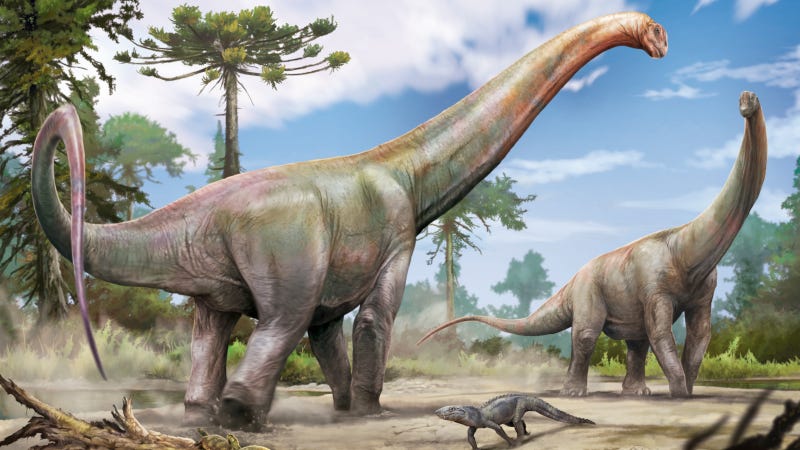
Artistic reconstruction of the new dinosaur from Maranhão state. It was 20 meters long and had a European relative. (CREDIT: Jorge Blanco)
A giant dinosaur lay buried about eight meters below a construction site in northeastern Brazil, hidden in sediments so old that the first people to see its bones thought they might belong to Ice Age mammals. Instead, the remains turned out to be something far older and far larger. It was a new species of long-necked sauropod that stretched roughly 20 meters, or about 65 feet, from head to tail.
The animal, named Dasosaurus tocantinensis, lived about 120 million years ago in what is now Maranhão state. Its discovery, described in the Journal of Systematic Palaeontology, adds a new branch to South America’s dinosaur record. It also hints at an older story of movement between continents that no longer touch.
For researchers, the surprise was not just the size of the animal. It was where its closest known relative turned up: Spain.
A road cut, an 8-meter slope, and a very old skeleton
The fossils were first spotted by archaeologist Daniel Ribeiro da Silva during monitoring work at a road-rail terminal in the city of Davinópolis, near Imperatriz. Such monitoring is required during environmental licensing. In this case it caught something unusual emerging from the base of a steep cut in the ground.
Elver Luiz Mayer, now a professor at the Federal University of the São Francisco Valley, was contacted in 2021 while working in Pará. At first, the bones were thought to belong to megafauna mammals that may have lived alongside ancient humans. Their depth quickly changed that idea.
“Given its depth of about eight meters, I realized that it was much older. The age of the geological formation was already known from previous research and indicated that it was material from the transition from the Lower to the Upper Cretaceous, about 120 million years ago,” Mayer said.
That set off a broader investigation involving a multidisciplinary team. The fossils were prepared in Pará, later returned to Maranhão, and are now housed in São Luís at the State Center for Natural History and Archaeology Research.
The specimen includes tail vertebrae, ribs, foot bones, arm and leg bones, and a femur measuring 1.5 meters. Max Langer of the University of São Paulo said that makes it a relatively complete find by sauropod standards. There is the possibility that more of the same individual still remains underground.
The biggest dinosaur yet known from Maranhão
Maranhão already had dinosaurs on the books, including the smaller diplodocid Amazonsaurus maranhensis, estimated at about 10 meters long. This one was different.
“It’s the largest known dinosaur for Maranhão, which has other species, but not sauropods like this one; rather, it has smaller ones, such as the diplodocid Amazonsaurus maranhensis, which was about 10 meters long,” Mayer said.
The new dinosaur belongs to Somphospondyli, a broader sauropod group that includes titanosaurs and their relatives. In Brazil, most known members of that group come from much later deposits and belong to Titanosauria. That is one reason Dasosaurus matters. It pushes attention northward, into older Early Cretaceous rocks. This shows that the region held a richer dinosaur fauna than the fossil record once suggested.
Its name carries local geography with it. “Daso” comes from the Greek for forest, a nod to the wooded landscape associated with Maranhão, while “tocantinensis” refers to the nearby Tocantins River.
A Brazilian dinosaur with a Spanish cousin
When the team tested the animal’s place on the dinosaur family tree, Dasosaurus emerged as the sister species of Garumbatitan morellensis, a sauropod from the late Barremian of Spain.
That close relationship matters because these animals lived on landmasses separated today by the Atlantic. The researchers argue that the Brazilian lineage likely dispersed from Europe into Africa and then into South America sometime between 140 million and 120 million years ago. At that time continental connections still made such movement possible.
Their biogeographic analyses point to a European origin for the branch that later produced both the Spanish and Brazilian species. Northern Africa appears to have been the likely bridge into South America. This was possible while those regions were still connected within Gondwana or linked through shifting Early Cretaceous land routes.
The finding adds support to the idea that dinosaur faunas moved between Europe and Gondwanan lands more easily than modern maps would suggest. It also gives northeastern Brazil a clearer place in that traffic.
Still, the study is cautious in places. The exact rock unit at the site remains under discussion, and the authors note that further geological work is needed to place the fossil-bearing beds more precisely. Some of the timing in the biogeographic models also carries uncertainty. The researchers note that younger divergence dates do not fit the known age of the Spanish species as well as earlier ones do.
Clues inside the bones
The outside of the skeleton told one part of the story. The inside told another.
Bone microstructure examined by Tito Aureliano and Aline Ghilardi of the Federal University of Rio Grande do Norte showed an adult animal with heavy internal bone remodeling. The femur and tibia preserved an external fundamental system, a sign that growth had slowed and the animal had reached adulthood. But the pattern did not fully match either older sauropods or later titanosaurs.
Instead, Dasosaurus appears to sit in between.
Its tissues preserved some primary bone seen in earlier forms, but also showed intense secondary remodeling more typical of titanosaurs, a group famous for fast growth and extreme body size. That suggests the shift toward those high bone-recycling rates may have begun earlier in titanosauriform evolution than scientists had thought.
The size estimate of about 20 meters should be treated carefully, though. The authors describe it as tentative because the femur is incomplete.
They are equally careful with the rib histology. The rib did not preserve the same growth markers as the leg bones, reinforcing the team’s view that ribs alone are not reliable for estimating age or growth stage.
Fossils, bulldozers, and a scientific paradox
The discovery also underlines an uncomfortable fact about paleontology in Brazil: some of the country’s most important fossils come to light because construction cuts into the ground before scientists ever get there.
“Brazil is a tropical country with dense vegetation. Geologists and paleontologists rely heavily on human activity to excavate, expose the rocks, and reveal the fossils. If we map Brazil’s fossil sites, we’ll see highways and quarries. These projects are important for understanding our heritage. But it’s obvious that specialized monitoring and artifact recovery are necessary, which doesn’t always happen,” Langer said.
That tension runs through the story of Dasosaurus. The same kind of project that can destroy a fossil site also opened a window into a buried ecosystem from the late Aptian.
“That’s why it’s urgent to foster closer cooperation between the parties to reconcile construction projects with federal legislation on fossils and promote new discoveries while ensuring the proper preservation of our heritage,” Mayer said.
The team is now negotiating with the construction company to continue excavating the site. More bones from the same animal may still be there, waiting in the clay.
Research findings are available online in the Journal of Systematic Palaeontology.
The original story "Brazilian dinosaur discovery points to an ancient route from Europe to South America" is published in The Brighter Side of News.
Related Stories
- Student discovers new carnivore dinosaur 3x older than T. rex
- CT scans reveal a new species of baby dinosaur hidden in rock for 100 million years
- 250-million-year-old Australian ‘sea-salamander’ sheds new light on the dawn of the dinosaurs
Like these kind of feel good stories? Get The Brighter Side of News' newsletter.
Hannah Shavit-Weiner
Medical & Health Writer
Hannah Shavit-Weiner is a Los Angeles–based medical and health journalist for The Brighter Side of News, an online publication focused on uplifting, transformative stories from around the globe. Having published articles on AOL.com, MSN and Yahoo News, Hannah covers a broad spectrum of topics—from medical breakthroughs and health information to animal science. With a talent for making complex science clear and compelling, she connects readers to the advancements shaping a brighter, more hopeful future.