Bee-inspired navigation system lets tiny robots fly without GPS
Scientists created a bee-inspired drone system that navigates long distances using just 42 kilobytes of memory.

 Edited By: Joseph Shavit

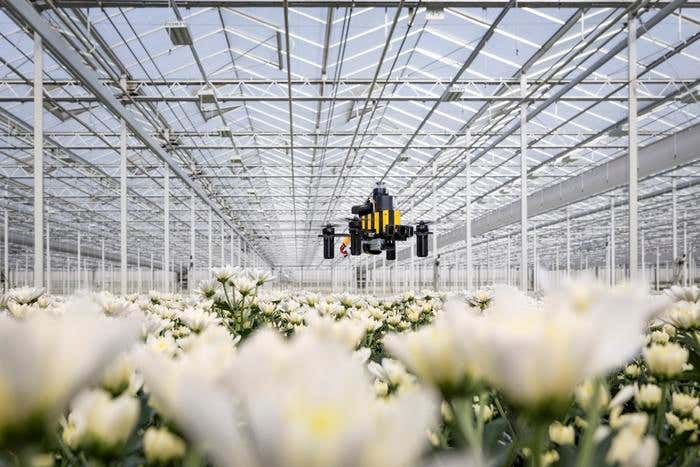
Researchers developed Bee-Nav, a honeybee-inspired system that allows tiny drones to navigate and return home efficiently. (CREDIT: Delft University of Technology – Micro Aerial Vehicles Lab)
Bee-inspired drone navigation could change how tiny robots move through greenhouses, warehouses and disaster zones. By pairing rough motion estimates with learned visual memories, Bee-Nav guides drones home over long distances, opening a practical path for smaller, cheaper autonomous flight.
A drone buzzes through a greenhouse, weaving between rows of tomatoes. Another inspects a warehouse ceiling for damage. A third searches a disaster site where GPS signals fail. These scenes sound futuristic, yet one major obstacle has slowed them down for years: navigation.
Small drones struggle to find their way without carrying heavy computers and large batteries. Most modern navigation systems rely on detailed maps and powerful processors, making lightweight robots expensive and energy-hungry.
Now, scientists led by Delft University of Technology in the Netherlands may have found a simpler answer by copying one of nature’s best navigators: the honeybee.
Their new system, called Bee-Nav, allows tiny drones to travel hundreds of meters and still return home using a neural memory as small as 42 kilobytes. The findings were published in the journal Nature.
The project brought together roboticists from Delft University of Technology and biologists from Wageningen University and the Carl von Ossietzky University of Oldenburg in Germany. Together, they created a navigation strategy inspired by how bees learn their surroundings after leaving the hive.
“We were fascinated by the fact that honeybees can fly far away from home along winding paths, yet return almost straight back,” said Guido de Croon, professor of Bio-inspired AI for drones at Delft University of Technology.
Why Small Drones Have Trouble Navigating
Most robots today navigate by building detailed maps of the world around them. These systems often require hundreds of megabytes of memory and powerful processors to calculate routes in real time.
That works for large autonomous vehicles, but not for tiny flying robots.
Small drones have strict weight and energy limits. They cannot carry advanced graphics processors or large batteries. As a result, many miniature drones remain restricted to small indoor spaces or carefully controlled environments.
The previous best tiny navigation systems could only work in spaces about four by five meters wide. Even then, they needed roughly 500 kilobytes of memory.
Honeybees offer a striking contrast.
Despite having tiny brains, bees can travel kilometers away from their hive and still return safely. Scientists have long known that bees rely partly on odometry, a process similar to counting steps. Bees estimate distance and direction by tracking visual motion during flight.
But odometry alone is imperfect. Small errors slowly build over time, causing navigation drift. Bees solve this problem using visual memory. They memorize how the environment looks near important locations like their hive.
For years, researchers understood insect odometry fairly well. Visual memory, however, remained much harder to explain. Scientists also struggled to combine both systems into something practical for robotics.
Learning Like A Honeybee
The Bee-Nav system copies what bees do during their first flights outside the hive.
A young bee begins with short learning flights close to home. During these flights, it studies the surrounding environment from different directions. Later, after traveling much farther away, the insect uses those visual memories to help find its way back.
Bee-Nav follows the same strategy.
First, the drone performs a short learning flight near its home location. During this stage, it captures panoramic images using an omnidirectional camera. At the same time, it estimates its position using path integration.
A tiny neural network then learns to connect those images with a “home vector,” which estimates both the direction and distance back home.
“Like an insect, the robot may not always know exactly where home is,” said Dequan Ou, a Ph.D. candidate at Delft University of Technology and first author of the paper. “Home may be too small to see, or hidden behind some trees. So we trained the neural network using odometry estimates of the direction and distance home, even though these become less accurate over time.”
The key challenge was whether noisy odometry data would still allow the drone to learn meaningful visual memories.
It did.
Tiny Memory, Long Flights
The researchers first tested Bee-Nav in computer simulations.
The results surprised even the team. The drone only needed to learn a very small area around home to navigate over much larger distances. In some simulations, the learned area covered less than 1% of the total flight area.
The neural network itself remained incredibly small. One version used just 3.4 kilobytes of memory. A larger attention-based version required only 42.3 kilobytes.
For comparison, map-based navigation systems often require memory thousands of times larger.
The team then moved to real-world tests.
Inside a 10-by-10-meter indoor arena, the drone successfully returned within half a meter of home during every flight. It completed 48 successful homing tests.
Later experiments took place in much larger indoor spaces, including hangars measuring 30 by 40 meters. Flights between 30 and 110 meters ended successfully every time.
The drone first flew outward using path integration. Because path integration drifted over time, it often missed the exact home position. Once the drone entered the learned visual area, however, the neural network corrected the error and guided the robot home.
Outdoor Flights Push The System Further
The most dramatic tests happened outdoors at the Dutch drone research field lab Unmanned Valley in Valkenburg.
There, the drone traveled between 200 and 600 meters before returning home.
In calmer weather, success rates reached 80%. In stronger winds, success dropped to around 50 to 70%.
Wind created a major challenge because it forced the drone to tilt sharply. That distorted the panoramic images used for navigation.
To compensate, researchers adjusted how the system processed images. In some cases, it used measurements of pitch and roll. In others, it detected the horizon line directly from the images themselves.
Even with those challenges, the drone still demonstrated long-range navigation using a neural network smaller than many simple smartphone photos.
“The experiments are very encouraging,” said Dequan Ou. “But they also show that our current system needs to become more robust in real-world conditions.”
Real-World Uses Could Arrive Quickly
The research could open the door to entirely new types of lightweight robots.
One promising use involves greenhouse monitoring. Tiny drones could inspect crops for diseases or pests without risking injury to workers nearby. Because Bee-Nav requires little computing power, drones can stay lightweight and energy efficient.
Warehouses could also benefit. Small autonomous drones might track inventory or inspect equipment in areas where GPS does not work.
The system may even help during emergency response missions. Tiny drones could search damaged buildings or dangerous industrial sites without needing large onboard computers.
Importantly, Bee-Nav does not attempt to build a full map of the world. Instead, it focuses on a simpler goal: leaving home, performing a task and returning safely.
That simplicity gives the system remarkable efficiency.
Lessons From Nature Continue To Shape Robotics
The project also gives scientists new insight into how insects may navigate.
The study suggests that bees may not need perfect internal maps to return home. Instead, they may combine imperfect path integration with learned visual memories in surprisingly efficient ways.
The drone’s return paths sometimes showed slight winding motions similar to real bee behavior. The neural network also learned both distance and direction estimates, which matches biological evidence that bees know roughly how far they are from their hive.
Researchers now hope to make the system even more capable. Future versions could include better landing precision, improved search behavior when navigation fails and more accurate heading sensors.
Scientists also want to understand when tiny neural networks are enough and when larger systems become necessary. Some environments, such as long hallways or open fields, provide fewer visual landmarks.
Still, Bee-Nav already demonstrates something powerful: small robots may not need massive computers to navigate intelligently.
Sometimes nature solved the problem long ago.
Practical Implications of the Research
Bee-Nav could help make autonomous drones cheaper, lighter and safer. Because the system requires very little memory and computing power, future drones may fly longer while using less energy. This could reduce costs for industries that rely on inspections, monitoring or automated delivery systems.
The technology may also improve agriculture. Lightweight drones could monitor crops inside greenhouses and detect disease earlier, helping farmers reduce waste and protect food supplies. In warehouses and industrial sites, small robots could inspect dangerous or hard-to-reach spaces without putting workers at risk.
For scientists, the study provides a new framework for understanding insect navigation and brain efficiency. It also shows how biological systems can inspire practical engineering solutions. Future research may combine Bee-Nav with additional sensors and learning systems to create even more capable autonomous robots.
Research findings are available online in the journal Cell.
The original story "Bee-inspired navigation system lets tiny robots fly without GPS" is published in The Brighter Side of News.
Related Stories
- The hidden costs of climate change for bees and wasps
- Tiny flapping drone matches insect speed with an AI brain
- SHIELD protects drones from cyberattacks midflight in real time
Like these kind of feel good stories? Get The Brighter Side of News' newsletter.
Rebecca Shavit
Writer
Based in Los Angeles, Rebecca Shavit is a dedicated science and technology journalist who writes for The Brighter Side of News, an online publication committed to highlighting positive and transformative stories from around the world. Having published articles on MSN, AOL News, and Yahoo News, Rebecca's reporting spans a wide range of topics, from cutting-edge medical breakthroughs to historical discoveries and innovations. With a keen ability to translate complex concepts into engaging and accessible stories, she makes science and innovation relatable to a broad audience.