Ancient elephant tooth reveals a wetland landscape shared with early humans
An ancient elephant tooth and pollen reveal woodland and wetlands in northern Israel around 700,000 years ago.
 Tel-Hai University Writer: Einat Paz-Frankel

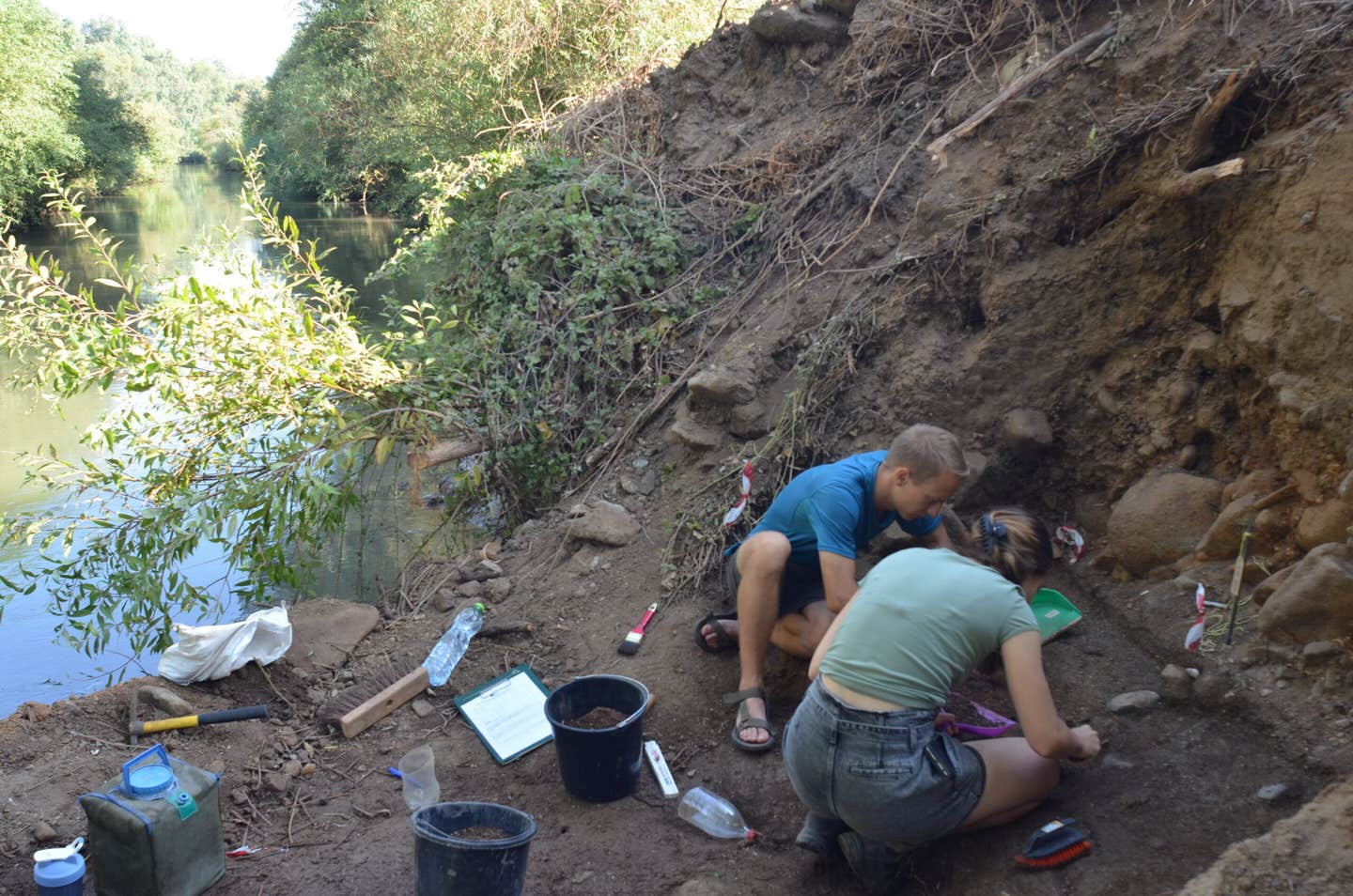
Tooth wear, enamel chemistry and pollen reconstruct a varied freshwater landscape. The findings do not establish that humans hunted the elephant. (CREDIT: Tel-Hai University of Kiryat Shmona in the Galilee and Hannah Farrell, University of Haifa)
A giant elephant’s tooth preserves traces of a greener northern Israel: wooded patches, grassy openings, marshes and waterways. Microscopic wear and chemical signals suggest the animal fed across this varied landscape around 700,000 years ago. Nearby stone tools place early humans within the same archaeological setting.
Hannah Farrell, a doctoral researcher at the University of Haifa, led the study in Quaternary Science Reviews. The team examined a molar and tusk fragments from North Bridge Acheulian, part of the Gesher Benot Ya’aqov sites complex. The findings connect an individual animal’s feeding history with the broader resources available to early humans.
The remains belonged to Palaeoloxodon antiquus, the straight-tusked elephant, among the Pleistocene’s largest land mammals. Its tooth functions as an archive because different features preserve different information. Shape identifies the animal, wear records feeding, and enamel chemistry provides clues about vegetation and water.
Locating the elephant in an ancient landscape
Excavators uncovered the remains in 2022 at North Bridge Acheulian, approximately two kilometers north of Gesher Benot Ya’aqov. Gonen Sharon of Tel-Hai University of Kiryat Shmona in the Galilee directed the excavation with colleagues. The locality lies in the upper Jordan Valley, near the southern part of today’s Hula Valley. It belongs to a region with a long record of human occupation.
Basalt handaxes and cleavers surrounded the elephant remains within the archaeological horizon. These implements belong to the Acheulian tradition, a widespread early stone-tool technology. Their association establishes a shared archaeological context, although it does not demonstrate how people encountered this particular animal.
A basalt flow immediately beneath the archaeological deposits provides the dating framework. The paper cites a newer estimate of 696,800 ± 6,700 years, reported through personal communication, alongside an older estimate of 658,000 ± 15,000 years. The approximately 700,000-year description therefore derives from underlying geology, rather than a direct date on the tooth.
This location matters because the Levantine Corridor connects Africa and Eurasia. Reliable freshwater and varied vegetation could have supported animals and human groups moving through it. Interpreting elephant remains within their surroundings helps distinguish possible resources from evidence of specific human behavior.
Reading the structure and wear of a molar
CT scanning allowed researchers to examine internal structures without first removing all the material surrounding the fossils. Three-dimensional reconstructions helped identify the tooth as an adult elephant’s left lower third molar. Such anatomical work complements other efforts to understand prehistoric elephants.
The specimen retained 11 enamel plates, with part of its front missing. Plate spacing, crown proportions and enamel patterns supported identification as a straight-tusked elephant rather than a mammoth. Establishing the species gave the environmental analysis a biological starting point.
Researchers then examined wear across eight enamel plates. They counted fine and coarse scratches alongside small and large pits, averaging about 29.2 pits and 21.8 scratches in the examined areas. This microwear approach uses damage from chewing to investigate ancient diets.
The combined pattern suggested mixed feeding with a browsing emphasis. The elephant likely ate leaves and other woody vegetation while also consuming grasses. Larger pits and gouges may reflect tougher foods, but the marks do not provide a precise menu or measure every plant’s contribution.
Chemistry follows feeding and drinking over time
Carbon and oxygen isotopes added a longer perspective. Isotopes are forms of an element with different masses, and their proportions in enamel reflect aspects of food and water. Similar methods allow researchers to investigate ancient mobility through chemical traces preserved in teeth.
The team sampled approximately 60 millimeters along the enamel’s growth direction. That sequence represents an estimated three to six years of the elephant’s life. Sampling successive positions allowed researchers to look for change rather than relying on a single average measurement.
Carbon values stayed within a narrow range, approximately −11.7 to −10.8 parts per thousand. In the study’s interpretation, they fit a diet from relatively well-watered environments. The signal supports dependable access to suitable vegetation during the sampled interval, without establishing uninterrupted conditions across hundreds of thousands of years.
Cheryl A. Makarewicz contributed isotope expertise, while Nimrod Marom contributed archaeozoology, the study of animal remains in archaeological settings. Minji Jin and Dafna Langgut of Tel Aviv University investigated pollen. Bringing those specialties together allowed the team to compare independent environmental clues.
Oxygen values declined from about −6.6 to −9.5 parts per thousand. Their progressive change, rather than a repeating seasonal pattern, suggested possible movement between water sources along the Jordan system. As with other reconstructions using tooth chemistry, that explanation requires environmental context; it cannot identify an exact route.
Pollen places the animal among wetlands and trees
Sediment beneath the tooth supplied a separate environmental record. Two of three analyzed samples preserved pollen, allowing researchers to identify vegetation around the site. Such pollen records complement an animal’s dietary evidence by revealing plants it may not have eaten.
Tree pollen averaged 31.3% of the main assemblage, compared with 68.7% from non-tree vegetation. Grasses contributed approximately 16.4%. Oak, pine, cedar and cypress relatives pointed toward woodland within an open landscape, rather than an unbroken forest canopy.
Reeds, sedges, willow and tamarisk indicated marshes and riverbanks. Aquatic plants, including pondweed and waterlilies, added evidence of shallow freshwater habitats. Riverbank and wetland plants accounted for 20.5% to 32.6% of the reported assemblages.
These percentages describe recovered pollen, rather than directly measuring the fraction of ground covered by each habitat. Still, their combination agrees with the tooth’s mixed-feeding evidence. Together, the records support a landscape offering several types of plant resources within reach of freshwater.
A refuge hypothesis with a clear next step
The researchers interpret this habitat mixture as a potential ecological refuge. A network of rivers, wetlands and woodland could have supplied food and water through changing conditions. Climate modeling provided a further comparison, estimating approximately 600 millimeters of annual rainfall and an average temperature around 14.5°C. These are reconstructed conditions, rather than readings preserved directly in the tooth. The model supplies a regional setting for interpreting the more local fossil and pollen records.
That reconstruction gives environmental substance to discussions of human origins, while leaving the identities of the local toolmakers unresolved.
Elephants may also have shaped the landscape through browsing, trampling and moving vegetation. Such effects provide a plausible ecological context, but the tooth cannot quantify them at this locality. Likewise, an association with tools does not establish hunting, scavenging or use of this animal’s remains.
The study combines several records, but their scales differ: one elephant’s enamel, limited sediment samples and the wider archaeological landscape. More animals and dated environmental sequences could test whether the apparent refuge persisted through longer climatic changes. They could also help distinguish movement from changes in local water chemistry.
For now, the strongest takeaway is the agreement between feeding evidence and vegetation remains. The site offered a mosaic of habitats rather than a single uniform environment. Reconstructing those conditions helps explain the resources available to elephants and people without assuming a specific human-elephant interaction.
Dig deeper into ancient elephants and freshwater landscapes
These resources explore environmental reconstruction and earlier evidence from the Gesher Benot Ya’aqov complex.
- Bones and teeth isotopes as archives for palaeoclimatic, palaeoenvironmental and palaeoecological data: This review explains how skeletal chemistry can reconstruct climate, vegetation, diet and mobility, including the limits of those inferences. (Quaternary Science Reviews, June 2025)
- Evidence for the cooking of fish 780,000 years ago at Gesher Benot Ya’aqov, Israel: Fish remains from older deposits provide a separate investigation of freshwater resources and early human behavior. (Nature Ecology & Evolution, November 2022)
- The plant component of an Acheulian diet at Gesher Benot Ya‘aqov, Israel: Preserved plant remains document the diversity of potential foods within this broader archaeological setting. (Proceedings of the National Academy of Sciences, December 2016)
- Evidence of Hominin Control of Fire at Gesher Benot Ya’aqov, Israel: Burned material supplies evidence relevant to human use of an earlier landscape within the site complex. (Science, April 2004)
- A Butchered elephant skull and associated artifacts from the Acheulian site of Gesher Benot Ya’Aqov, Israel: Earlier elephant remains from the broader site complex provide a distinct case for investigating elephant–hominin interactions. (Paléorient)
Research findings are available online in the journal Quaternary Science Reviews.
The original story "Ancient elephant tooth reveals a wetland landscape shared with early humans" is published in The Brighter Side of News.
Related Stories
- Elephant-skin tiles could help buildings stay cool without air conditioning
- Elephant whiskers act like touch sensors built into the trunk
- 500,000-year-old elephant bone tool reveals advanced planning and skill in early human ancestors
Like these kind of feel good stories? Get The Brighter Side of News' newsletter.
Joshua Shavit
Writer and Editor
Joshua Shavit is a NorCal-based science and technology writer with a passion for exploring the breakthroughs shaping the future. As a co-founder of The Brighter Side of News, he focuses on positive and transformative advancements in technology, physics, engineering, robotics, and astronomy. Having published articles on AOL.com, MSN, Yahoo News, and Ground News, Joshua's work highlights the innovators behind the ideas, bringing readers closer to the people driving progress.